
Blog
The Round Brilliant, a Century On: Why One Cut Still Defines the Diamond

The shape in the public imagination
Across a crowded room, a small white flash at a left hand can be enough to identify the familiar engagement ring: a round stone held above a band, catching light with every gesture. In shop windows, family photographs and films, that outline has become the shape most people picture when they hear the word diamond. Its dominance is cultural as much as visual. A circle reads clearly at a glance, and the brilliant cut turns that simple outline into movement.
The style has endured because it can belong to very different tastes. A high solitaire can feel formal; a low setting with a slender band can look almost spare. The stone itself carries the same pattern of light through both. Unlike a silhouette tied to one fashion moment, the round has moved through changing ideas of romance and elegance without losing its place at the center of the ring.
A design shaped by mathematics
The modern round brilliant is often traced to Marcel Tolkowsky’s 1919 work on diamond proportions. Drawing on geometry and the behavior of light, he set out proportions intended to balance brightness, fire and the light returning through the top of the stone. His calculations did not invent every facet or settle every later debate, but they helped give the cut a lasting design logic: each angle contributes to how the whole diamond performs.
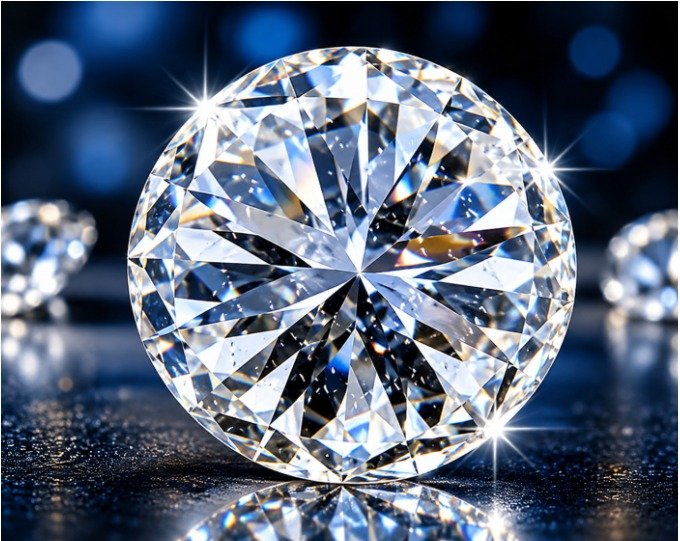
A standard round brilliant has 57 facets, or 58 when the small bottom culet is counted. These polished surfaces redirect light through the stone and back toward the eye. The result is a lively mix of white sparkle and flashes of color, not simply a bright surface. That balance makes the shape unusually sensitive to how well it is cut. A stone with poorly judged angles can let light escape through the bottom or sides, leaving the face less vivid.
That precision has helped the form travel through style history. Art Deco favored crisp geometry and strong contrast, yet the circle sat comfortably beside the period’s angular lines. Mid-century rings often gave it a more prominent, romantic setting. Today it appears in quiet, minimal designs as readily as in elaborate ones. The frame changes, but the shape does not need reinvention to feel current.
What matters when choosing a round cut diamond
For a buyer weighing a round cut diamond, cut quality deserves particular attention. It is graded on a scale of its own, separate from color and clarity. At GIA, the familiar cut grade, from Excellent to Poor, applies to round brilliant diamonds, while fancy shapes do not receive the same overall cut grade. A strong grade gives a useful starting point, but a careful look at the stone’s actual light return still matters.
Proportions can help explain what the grade is assessing. A table in roughly the mid-50s percent and a total depth around 59 to 62.5 percent are useful starting ranges for many well-performing stones. They are guides, not guarantees. Facet angles work together, and a number that looks promising on paper cannot show whether the diamond has an even pattern of brightness or distracting dark areas. A well-cut round diamond should look lively across its face, rather than bright only in a narrow spot.
Because a round cut diamond returns so much light, brilliance can soften the visibility of small inclusions. That may let a buyer choose a clarity grade below the highest available level without sacrificing what the eye sees, though the location and type of an inclusion still matter. Color can also be considered with a practical eye. A bright face-up appearance may make slight warmth less apparent, especially in some settings, but the metal and the stone’s size can affect how color reads. There is no need to spend equally at the top of every grading category when cut is doing so much of the visual work.
Rare Carat, a full-service jeweler and merchant of record, verifies every diamond in its own New York and New Jersey facilities before setting. For a buyer evaluating a round cut diamond, real images or video can reveal details that a grading report cannot: the pattern of light, any persistent dark areas and the way the stone looks from more than one angle. A jeweler’s inspection before setting adds another practical check, particularly when the finished ring will make small details harder to see.
Settings that let the circle speak
The solitaire is the clearest expression of the shape. With no neighboring stones to compete for attention, the outline and light pattern remain the focus. A pavé band adds a fine line of sparkle without changing the central stone’s familiar profile. A three-stone design gives the round center company and can make a ring feel more substantial, while a halo surrounds it with smaller diamonds for a brighter, more ornate effect.
Each setting changes the impression, not the identity of the cut. A low setting can suit a pared-back wardrobe and daily wear; a taller head gives the stone more presence from the side. A halo may make the center appear larger, while a plain band gives its proportions room to register. Practical details count too: the height of the setting, the security of its prongs and whether the ring can be resized all shape how easily it becomes part of ordinary life.
The same jeweler offers 30-day returns, free resizing and a lifetime manufacturing warranty. Those details belong in the decision alongside the stone’s appearance, since a ring is both an image and an object worn repeatedly. A buyer choosing a round diamond can appreciate its symbolism while still asking how it is inspected, how the setting is made and what support follows the purchase.
A classic that keeps its place
The round brilliant’s endurance is not a refusal of change. It has moved from mathematical study to Art Deco ornament, mid-century sentiment and today’s quieter settings, taking on each era’s styling without losing its own character. Its proportions give the eye a familiar order; its facets keep that order in motion. The shape can be dressed up or stripped back, and still read as a diamond before any explanation is offered.
That is why a classic never needs defending. The shape does not claim to be the only beautiful cut, or the right one for every ring. It has simply earned its place through clarity of form and a durable command of light. A century after Tolkowsky’s calculations, the circle remains instantly legible, and still has something to show.

Virat Kohli Net Worth: Cricket, Brands and Business

Richest Cricketers in the World: Reading the Top 10

Supply Chain Software Architecture: APIs, Data Platforms, and AI Layers Explained

Old Hollywood on the Hand: How Classic Screen Glamour Shapes Today’s Ring Designs

Styling the Oval: Settings, Stacks and Proportions That Flatter

The Round Brilliant, a Century On: Why One Cut Still Defines the Diamond

Area Rug Sizing Mistakes and How to Avoid Them

Lexie Wiggly: The Untold Story of J.B. Mauney’s Ex-Wife and Her Life Today

Lana Parrilla Net Worth: Salary, Career, Income and Personal Life

StudiosoApp.com: Everything You Need to Know About This Music Learning App

How to Make Kofta Kebabs at Home Without Overthinking It

Ethan Klein Net Worth: YouTube H3 Podcast and His Wealth

Oleksandra Zelenska: Who Is Volodymyr Zelensky’s Daughter?

Who Is Angel Iris Murphy Brown? All About Mel B’s Child

Kai Dugan: Everything to Know About Jennifer Connelly’s Son

Rebecca Liddicoat: What Happened to RG3’s First Wife After Divorce?

Beyond the Interior: Home Improvements That Transform Your Entire Property

Lex Fridman Net Worth: Salary, Podcast and YouTube Money

Building a Competitive Online Presence with Link Building Services and SEO Packages

Christine Marinoni: Everything About Cynthia Nixon’s Wife
Virat Kohli Net Worth: Cricket, Brands and Business
Richest Cricketers in the World: Reading the Top 10
Supply Chain Software Architecture: APIs, Data Platforms, and AI Layers Explained
Old Hollywood on the Hand: How Classic Screen Glamour Shapes Today’s Ring Designs
Styling the Oval: Settings, Stacks and Proportions That Flatter
The Round Brilliant, a Century On: Why One Cut Still Defines the Diamond
Area Rug Sizing Mistakes and How to Avoid Them
Lexie Wiggly: The Untold Story of J.B. Mauney’s Ex-Wife and Her Life Today
Lana Parrilla Net Worth: Salary, Career, Income and Personal Life






