
Blog
Old Hollywood on the Hand: How Classic Screen Glamour Shapes Today’s Ring Designs

A hand turns in a pool of studio light, and a pale stone flashes against a dark glove. In the close-up, every line of the setting seems deliberate, every glint sharpened by the black and white frame. That visual grammar still shapes the engagement rings couples choose today, even when the stones and metals appear in full color.
When the Screen Made White Metal Shine
Black and white cinema made jewelry part of the image, not a detail at its edge. White metal picked up light cleanly, while bright stones stood out against shadow, satin and dark tailoring. A small movement could send a sharp spark across the screen. The effect depended on silhouette as much as size: a crisp outline read clearly, while intricate surfaces gave the camera fine patterns to catch.
That visual language made a ring feel like a piece of personal theater. It could suggest refinement through a narrow band and a single stone, or announce confidence through a broad setting with a strong profile. The camera favored clarity. It made a diamond’s brightness legible and gave a setting’s shape its own presence, qualities that continue to appeal in close-up photographs and everyday wear.
Screen glamour also gathered ideas from the jewelry eras around it. Edwardian delicacy, Art Deco geometry, the warmer gold of the 1940s and the large solitaires of the 1950s each offered a different way to turn light into character. Their influence is not a matter of copying a past look exactly. It lies in choosing the detail that still feels expressive.
Edwardian Lightness, Worked Like Lace
From about 1901 to 1915, Edwardian jewelry favored platinum and lace-like filigree. The metal could be drawn into fine openwork, creating airy surfaces that seemed delicate without appearing flimsy. Small details mattered: pierced patterns, milgrain edges and slender lines gave a ring a sense of hand-finished intricacy. Against a dark sleeve or glove, that fine work would register as a pale, intricate outline.
For a present-day couple, the appeal may be less about recreating a period piece than capturing its lightness. A slim band with milgrain along the edge can bring an antique note to a clean stone. A halo can suggest the same careful framing, surrounding a center diamond with a fine border rather than a heavy wall of metal. These details suit someone who likes romance expressed through craftsmanship, not excess.
Art Deco’s Graphic Lines
In the 1920s and 1930s, Art Deco jewelry favored geometry, step cuts and contrast. Emerald and asscher cuts offer broad, orderly facets rather than the glittering pattern of a round brilliant. Their long planes create a measured flash, and their clipped corners give the outline a distinct architectural quality. Paired with contrasting stones or dark details, the effect is precise and striking.
That clarity translates easily to a contemporary ring. A step-cut center stone can stand alone in a low, clean setting, or sit within a geometric frame that echoes the period without turning the whole design into costume. The shape does much of the work. A crisp outline feels composed from across a room, then reveals its subtle facets in closer light.
Art Deco influence is especially compelling for couples drawn to order and strong proportions. A narrow band can heighten the center stone’s shape; tapered shoulders can guide the eye toward it. The result may feel both vintage and modern, because the geometry has never depended on a particular decade to look assured.
Warm Gold, Recast for Today
The 1940s brought a bolder note, with yellow and rose gold giving jewelry a warmer, more substantial presence. Against the cool brightness prized by black and white photography, these metals added a different kind of drama. Their tone could make a stone feel softer, or give a simple silhouette a confident, sculptural character.
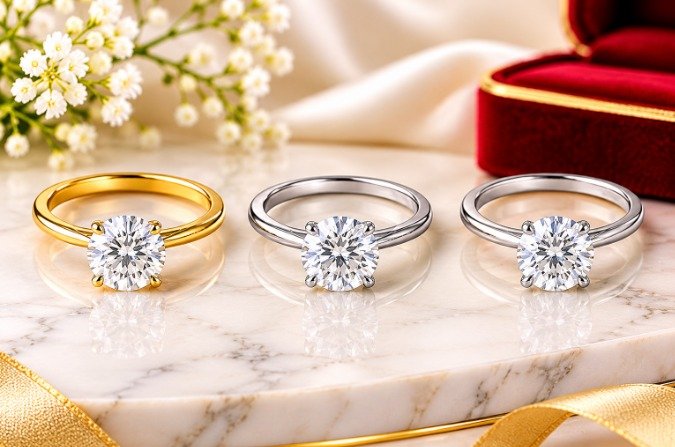
Today’s versions can keep that period’s strength while editing away its weight. A rounded gold band beneath a crisp stone creates a pleasing shift in texture. A setting with broad shoulders can feel expressive without crowding the center. For couples who like period cues, modern engagement ring designs at Rare Carat include halos, milgrain details and clean step-cut solitaires that translate these eras into distinct, wearable forms.
Rare Carat is a direct fine jewelry retailer, and it verifies every diamond in its own New York and New Jersey facilities before setting. That attention to the stone matters in a design where the metal and outline frame, rather than obscure, the center. A warm band can change the mood, but the diamond’s cut and proportions still determine how its light moves.
The Solitaire Takes the Close-Up
By the 1950s, large round brilliant solitaires had become a defining image of screen-era glamour. Their rounded outline and lively facets were made for a concentrated burst of light. Set above a simple band, a single center stone held the frame with little ornament around it. The look was direct, polished and unapologetically grand, a silhouette that still reads instantly as a statement.
Couples drawn to that scale can take a cue from the era without treating size as the only measure of presence. A five carat natural stone brings the same expansive spirit to a contemporary setting. Rare Carat 5 carat diamond engagement rings speak to that bold solitaire tradition, while a restrained band can keep the overall design balanced. The shape of the setting, the height above the hand and the wearer’s preferred proportions all affect the impression.
The most lasting screen-inspired rings do not need to resemble props from a vanished world. They borrow one clear idea: the Edwardian delicacy of a fine edge, the discipline of a step cut, the warmth of gold or the assured simplicity of a large round stone. Each gives a couple a way to make a ring feel personal while carrying a little of that old cinematic glow into ordinary light.

Virat Kohli Net Worth: Cricket, Brands and Business

Richest Cricketers in the World: Reading the Top 10

Supply Chain Software Architecture: APIs, Data Platforms, and AI Layers Explained

Old Hollywood on the Hand: How Classic Screen Glamour Shapes Today’s Ring Designs

Styling the Oval: Settings, Stacks and Proportions That Flatter

The Round Brilliant, a Century On: Why One Cut Still Defines the Diamond

Area Rug Sizing Mistakes and How to Avoid Them

Lexie Wiggly: The Untold Story of J.B. Mauney’s Ex-Wife and Her Life Today

Lana Parrilla Net Worth: Salary, Career, Income and Personal Life

StudiosoApp.com: Everything You Need to Know About This Music Learning App

How to Make Kofta Kebabs at Home Without Overthinking It

Ethan Klein Net Worth: YouTube H3 Podcast and His Wealth

Oleksandra Zelenska: Who Is Volodymyr Zelensky’s Daughter?

Who Is Angel Iris Murphy Brown? All About Mel B’s Child

Kai Dugan: Everything to Know About Jennifer Connelly’s Son

Rebecca Liddicoat: What Happened to RG3’s First Wife After Divorce?

Beyond the Interior: Home Improvements That Transform Your Entire Property

Lex Fridman Net Worth: Salary, Podcast and YouTube Money

Building a Competitive Online Presence with Link Building Services and SEO Packages

Christine Marinoni: Everything About Cynthia Nixon’s Wife
Virat Kohli Net Worth: Cricket, Brands and Business
Richest Cricketers in the World: Reading the Top 10
Supply Chain Software Architecture: APIs, Data Platforms, and AI Layers Explained
Old Hollywood on the Hand: How Classic Screen Glamour Shapes Today’s Ring Designs
Styling the Oval: Settings, Stacks and Proportions That Flatter
The Round Brilliant, a Century On: Why One Cut Still Defines the Diamond
Area Rug Sizing Mistakes and How to Avoid Them
Lexie Wiggly: The Untold Story of J.B. Mauney’s Ex-Wife and Her Life Today
Lana Parrilla Net Worth: Salary, Career, Income and Personal Life






