
Blog
Duaction: The New Way to Turn Learning Into Real Skills

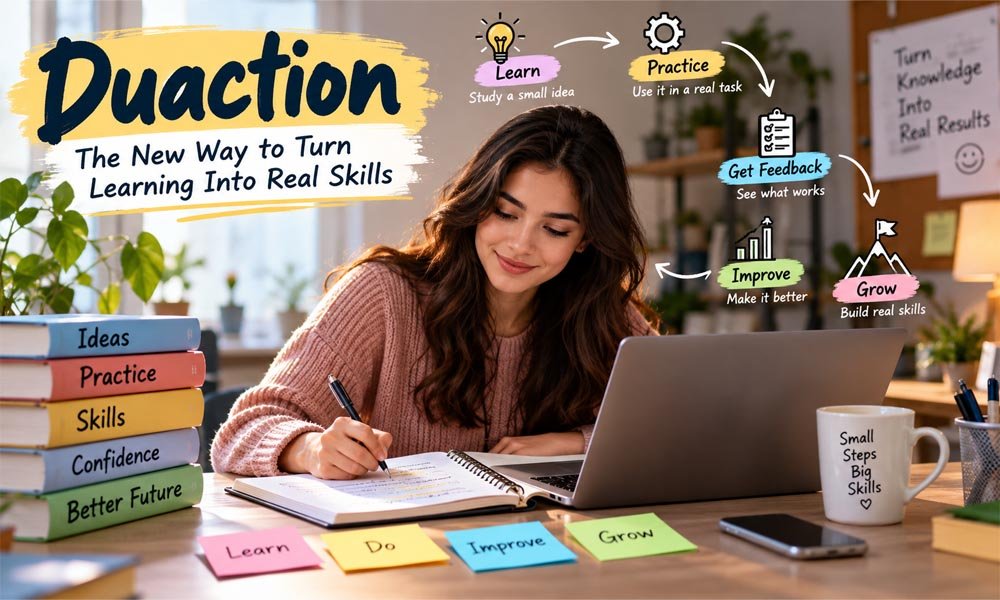
Learning is not only about reading books or remembering facts. In 2026, people also need skills they can use in daily life and at work. This is where Duaction becomes useful. It brings learning and practice together.
Think about learning to ride a bike. You can read about balance all day. Yet you will not truly learn until you get on the bike. Duaction follows the same simple idea. You learn something, then you try it.
In this article, we will explain what Duaction means and how it works. We will also look at its learning cycle, benefits, and differences from older learning styles. Later, we will explore how it can work in schools, jobs, and online learning.
What Is Duaction?
Duaction is a learning idea that joins study with action. A person learns one small idea and then uses it in a task. The goal is to turn new knowledge into a skill while the lesson is still fresh.
The name is often explained as a mix of “dual” and “action.” Dual means two parts. Here, those two parts are learning and doing. They work together instead of being kept far apart during the learning process.
Duaction is still a newer term. It does not have one fixed meaning used by every school or expert. However, its main idea is close to active learning and learning through experience. In simple words, you learn, try, and improve.
How Does Duaction Work?
Duaction starts with a small lesson. A learner may read a short page, watch a video, or listen to a teacher. The lesson should focus on one clear skill instead of giving too much information at once.
Next comes action. The learner uses the new idea right away. A coding student may learn one simple command and then write a tiny program. A writing student may learn how to create a good opening and then write one.
After the task, the learner checks the result. A teacher, friend, trainer, or online tool may give feedback. The learner sees what worked and what went wrong. Then, they make changes and try again with better understanding.
The Duaction Learning Cycle
The basic Duaction learning cycle is easy to remember: learn, act, review, improve, and repeat. Each part supports the next one. This creates a steady path from new information to useful skill.
Imagine that Mia wants to learn public speaking. First, she learns how to make eye contact. Next, she gives a short talk. She watches her result, gets feedback, and notices that she looks down too often.
Mia then tries the talk again. This time, she makes more eye contact. One small lesson has now become real practice. The same cycle can continue with voice, body movement, timing, and other speaking skills.
Why Duaction Can Make Learning Better
One useful part of Duaction is that learners can see why a lesson matters. They do not have to wonder when they will use it. They get a chance to test the new idea almost right away.
Practice can also help a lesson become easier to remember. Reading about a skill gives useful information. Using that skill adds an experience. The learner can connect the idea with something they actually did, saw, or solved.
Duaction may also help build confidence. Learners can start with small and safe tasks. Mistakes are not the end of learning. They show what needs more work. With each new try, a person can become more comfortable with the skill.
Duaction vs Traditional Learning
Traditional learning often starts with a lot of theory. Students may listen to lessons, read books, take notes, and study for tests. Practical work may come later through a large project, lab, or job placement.
Duaction makes the space between learning and doing much shorter. A teacher may explain one idea and then ask students to use it within minutes. This gives learners a quick chance to see whether they truly understand the lesson.
Still, Duaction does not mean books or theory are bad. Strong background knowledge is very important. Some subjects need deep study before practice is safe. The main idea is to connect useful theory with action at the right time.
Duaction vs Learning by Doing
Duaction and learning by doing are very close ideas. Both believe that people can build skills through practice. However, Duaction can be viewed as a more planned cycle where a clear lesson and a related action stay closely connected.
For example, someone may learn cooking simply by helping in a kitchen. That is learning by doing. In a Duaction-style lesson, the person may first learn how to cut vegetables safely, practice that exact skill, receive feedback, and then improve.
The review step is important. Action alone does not always teach the right lesson. A person can repeat the same mistake many times. Duaction works best when practice is followed by feedback, thought, and another chance to improve.
Duaction in Schools and Colleges
Duaction can work well in schools and colleges. A teacher can explain one small idea and then give students a task. This helps students see how the lesson connects with something they can actually do.
Think about a science class. Students may first learn why plants need light. They can then grow plants in different places and watch what happens. The lesson becomes something they can see, test, and understand.
The same idea works in writing, coding, art, and business. Students can write stories, build small programs, create designs, or study real business problems. Duaction gives them a chance to turn classroom knowledge into useful skills.
Duaction for Jobs and Workplace Training
Workplaces also need people who can use what they learn. Reading a training guide can help, but workers often need practice before they feel ready. Duaction can bring that practice into the training process.
Imagine a new customer service worker. The worker learns how to handle an unhappy customer. Next, a trainer acts like a customer and starts a practice call. The worker can test the lesson without facing a real customer.
This approach can also work for software, safety, sales, and other job skills. Workers can practice in a safe setting first. They can find mistakes, receive help, and improve before doing the same task in real work.
Duaction in Online Learning and Self-Study
Online learning is common in 2026. People can learn from home, at work, or while traveling. Duaction can make online lessons more active by adding a useful task after each small lesson.
A person learning a new language may watch a short lesson about greetings. Instead of moving straight to another video, they can say the words aloud or practice a short talk. This turns watching into active learning.
Self-study can work the same way. If you watch a coding lesson, build something small afterward. If you study writing, write a paragraph. The goal is simple. Do not only collect information. Find a way to use it.
Real-Life Examples of Duaction
Duaction can look different for each learner. A student learning coding may study how a loop works. The student can then write a tiny program using that loop. If the program fails, the student finds the problem and tries again.
A writing student may learn how to create a strong opening. Next, the student writes one. A teacher gives simple notes, and the student makes changes. One small lesson becomes a real writing skill through practice.
Even daily skills can use this method. Someone learning to cook may read how to make rice and then prepare it. Someone learning public speaking may study eye contact and give a short talk. Practice makes the lesson feel real.
Benefits and Limits of Duaction
Duaction has several useful benefits. It can make learning more active and give people a clear reason to study. Learners can also find their weak areas early because they test each new skill instead of waiting for a final exam.
It may also help people feel more confident. Small tasks give learners room to make safe mistakes. A wrong answer can show what needs more work. With good feedback, each mistake can become part of the learning process.
However, Duaction has limits. Some subjects need a lot of study before real practice is safe. Medical care and other high-risk work need trained teachers and safe practice settings. Theory should never be skipped when safety depends on it.
How to Use Duaction for Better Results
Start with one clear goal. Do not try to learn ten skills at the same time. For example, a new writer may focus only on writing a clear title. Once that skill improves, another skill can be added.
Next, choose a task that matches the lesson. If you learn about speaking, speak. If you learn about design, create a small design. The task should have a clear purpose. Random busywork will not give the same value.
Finally, check your work and ask what you can improve. Feedback may come from a teacher, trainer, friend, or trusted learning tool. Make one change and try again. This keeps the Duaction cycle moving forward.
Is Duaction the Future of Learning?
Education continues to change in 2026. Online courses, digital tools, AI, and virtual practice spaces give learners more ways to study and practice. This makes action-based learning easier to use in many places.
Still, Duaction should not be treated as a magic answer. People need facts, theory, good teachers, and time to think. Practical work is most useful when learners understand why they are doing it and receive helpful feedback.
The strongest learning may come from balance. People can study important ideas and then use them in safe, useful ways. Duaction offers a simple way to create that link between knowing something and being able to do it.
Conclusion
Duaction is a simple learning idea with a practical goal. It connects study with action. Instead of learning for a long time before trying something, learners can study a small idea and put it into practice soon after.
The process is easy to understand. Learn something, try it, check the result, improve, and try again. This cycle can be used in schools, workplaces, online courses, and even when learning alone at home.
Duaction does not need to replace traditional education. It can work beside it. When theory, practice, feedback, and reflection come together, learners have a better chance to turn useful knowledge into skills they can use in real life.
(FAQs)
What is Duaction?
Duaction is a learning approach that connects study with action. A learner studies one small idea and then uses it in a real or practice task. This helps turn knowledge into a useful skill.
What does the word Duaction mean?
Duaction is often explained as a mix of “dual” and “action.” It points to two connected parts, learning and doing. However, Duaction is still a newer term and does not have one fixed academic meaning.
How does Duaction work?
Duaction uses a simple cycle. A person learns something, practices it, checks the result, gets feedback, and improves. The same process is then repeated with the next skill or a harder task.
Is Duaction the same as learning by doing?
They are very similar. Learning by doing focuses on gaining knowledge through experience. Duaction can be viewed as a more planned process where a short lesson is followed by practice, feedback, review, and another try.
What are the main benefits of Duaction?
Duaction can make learning more active and useful. It may help people understand lessons, find mistakes early, build confidence, and develop practical skills. Learners also see how new knowledge can be used in real situations.
Can Duaction be used in schools?
Yes. Teachers can explain a small topic and then give students a related task. Science experiments, writing activities, coding projects, role-play, and business cases are simple examples of how this approach may work.
Can Duaction help with job training?
Yes. Workers can learn a skill and practice it before using it in important work. Companies may use role-play, practice software, workshops, or safe job tasks to help workers gain useful experience.
Can I use Duaction for self-study?
Yes. You can use the method at home. After watching a lesson or reading a guide, complete a small task using what you learned. Check your work, find mistakes, and try again.
Does Duaction replace traditional learning?
No. Duaction does not need to replace books, teachers, lessons, or theory. Some subjects require deep study before practice. Duaction simply tries to connect useful knowledge with practical action at the right time.
Is Duaction a formally recognized learning model?
Duaction appears to be a newer and loosely used term rather than one fixed academic model. Its main ideas are similar to active learning, experiential learning, action learning, and work-based learning.
Continue reading: Tumbons: Everything You Need to Know in Simple Words

Press Release Distribution for Startups: A Practical Guide to Your First Announcement

WhatsonTech: How It Makes Technology Easy to Understand

Pasonet: Everything You Need to Know Before You Use It

Tatavel: Everything You Need to Know About This Travel Website

FRABOC: How It Worked, Why It Ended, and What Replaced It

Unity Leather Card Wallet: The Perfect Mix of Style and Comfort

Simpciry: How Small Changes Can Make a Big Difference in Your Life

Inside the Obsession With Chrome Hearts and CDG

The Importance of Music Apps in Austin, TX Youngsters

Letflix: Everything You Need to Know About Free Movies and TV Shows in 2026

Arbello Barroso: Where Is Luciana Barroso’s Ex-Husband Now?

Suzanne Bukinik: Everything to Know About Brad Falchuk’s Ex-Wife

Maria Jesus Pariente: What We Know About Enzo Maresca’s Wife

Who Is Astrid Menks? All About Warren Buffett’s Wife

Who Is April Dubois? All About Wesley Snipes’ Ex-Wife

Berkin Gökbudak: What to Know About Aslı Enver’s Husband

Who Is Kate Connelly? All About Bobby Flay’s Ex-Wife

Erika Riker: Where Is Randy Jackson’s Ex-Wife Now?

Andrea Sarubbi: Who Is Luke Kirby’s Wife and What Does She Do?

Patricia Rahman: The Full Story of James Marsters’ Ex-Wife
Press Release Distribution for Startups: A Practical Guide to Your First Announcement
WhatsonTech: How It Makes Technology Easy to Understand
Pasonet: Everything You Need to Know Before You Use It
Tatavel: Everything You Need to Know About This Travel Website
FRABOC: How It Worked, Why It Ended, and What Replaced It
Unity Leather Card Wallet: The Perfect Mix of Style and Comfort
Simpciry: How Small Changes Can Make a Big Difference in Your Life
Inside the Obsession With Chrome Hearts and CDG
The Importance of Music Apps in Austin, TX Youngsters
Letflix: Everything You Need to Know About Free Movies and TV Shows in 2026
-

 News1 month ago
Who Is Gigi Yallouz? Meet Owain Yeoman’s Wife and Jewelry Designer
-

 News1 month ago
Rajesh Nihalani: What We Know About Archie Panjabi’s Husband
-

 News2 months ago
Stephan Farmiga: Everything to Know About Vera Farmiga’s Brother
-

 News2 months ago
Tara Nadella: What We Know About Satya Nadella’s Daughter