
Blog
BrandRank.ai Normalization Transformation Rules: Everything You Need to Know

This is where BrandRank.ai normalization transformation rules become useful. These methods help group brand names and product details. They also help make AI reports more clear and easy to compare.
In 2026 AI tools play a big role in how people find products. In this guide we will explain how these rules work. We will also look at their main types and why they matter.
What Are BrandRank.ai Normalization Transformation Rules?
BrandRank.ai normalization transformation rules help explain how brand and product data can be grouped. The goal is to make names clear and easy to track. This helps people study what AI tools say about different brands.
For example a company may sell many products under different names. AI tools may suggest each product on its own. Normalization helps link those products to the right brand or parent company.
Transformation is a little different. It turns raw AI answers into useful records. These records can show which brand was named and which product was suggested. They may also show which sources an AI tool used.
BrandRank.ai has shared some of its grouping methods in public research. These include product-family and parent-company grouping. The full set of its private software rules has not been made public.
How Do BrandRank.ai Normalization Transformation Rules Work?
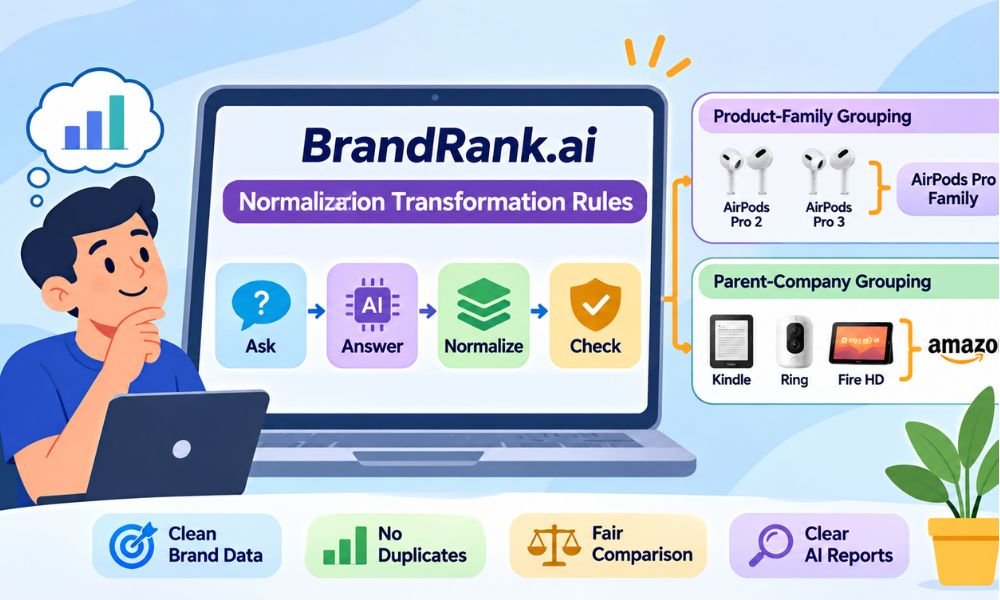
BrandRank.ai uses a research process with four main steps. These are Ask and Answer followed by Normalize and Check. Each step helps turn AI answers into data that researchers can study and compare.
The first step is Ask. Researchers give AI tools the same question. The next step is Answer. They collect what each tool says. This helps them see which products and brands the tools suggest.
Next comes Normalize. This step groups related products and brands. The last step is Check. Researchers review the results for errors. This helps stop wrong names or old details from changing the final report.
For example ChatGPT may suggest one product while another AI tool suggests a newer model. If both belong to the same product family they may be grouped for a fair comparison.
Why BrandRank.ai Normalization Transformation Rules Matter
AI tools do not always use the same names for products. One tool may use a full product name. Another may use a short name. Without clear rules these names may be counted as different products.
This can make reports hard to trust. A brand may seem to have fewer recommendations than it has. Another brand may appear more often because its name was counted in the wrong way.
BrandRank.ai normalization transformation rules help make these reports more useful. They support fair brand checks and help people see which companies receive AI recommendations. This is useful for businesses that want to study their online reach.
Still these rules do not make AI answers true on their own. They help organize the answers. People must still check facts and make sure each product belongs to the right company.
Continue reading: Oronsuuts: Everything You Need to Know About Homes in Mongolia
Main Types of BrandRank.ai Normalization Transformation Rules
There are different ways to group brand data. Two key methods in BrandRank.ai’s public research are product-family grouping and parent-company grouping. Each one helps answer a different question about AI recommendations.
Product-family grouping puts related product versions together. For example two versions of the same headphones may count as one family in a study. This helps show whether AI tools agree on a product line.
Parent-company grouping looks at who owns a product or brand. A large company may own several smaller brands. This method helps show how often products from the same parent company are recommended.
Other useful data rules cover brand names and website links. These are common ways to keep records clean. They should not be treated as confirmed private BrandRank.ai rules unless the company has shared them.
How BrandRank.ai Groups Brands and Products
A clear example comes from Apple. AirPods Pro 2 and AirPods Pro 3 are different versions of one product line. BrandRank.ai’s published research groups them under the AirPods Pro family when studying AI agreement.
Amazon gives us another example. Kindle and Fire HD are Amazon products. Ring also belongs to Amazon. These names can be grouped under Amazon when measuring recommendations at the parent-company level.
Soundcore offers one more example. It belongs to Anker. If an AI tool suggests a Soundcore product it can count toward Anker in a parent-company report. This helps show which companies gain recommendations through their brands.
But product details should not be lost. AirPods Pro 2 and AirPods Pro 3 are still different models. Good records keep their own names while also showing the product family they share.
BrandRank.ai Normalization Transformation Rules vs. Entity Resolution
Normalization and entity resolution may sound like the same thing. But they have different jobs. Normalization makes records more clear and alike. Entity resolution checks whether two records point to the same real brand or product.
Think of a shop called Bright Home. Another business may use the name Bright Home Studio. The names look close. But this does not prove that both shops belong to the same owner.
Entity resolution looks for proof. It may check official websites and company details. Once the match is clear normalization can help place the names into the right groups for reports and future checks.
This is why BrandRank.ai normalization transformation rules need careful use. A wrong match can change the results of a whole study. Keeping the original names helps people find and fix these mistakes later.
Key Benefits of BrandRank.ai Normalization Transformation Rules
One big benefit of BrandRank.ai normalization transformation rules is better data. These methods help keep brand names clear. They also reduce the chance of counting the same product twice. This makes reports easier to read and understand.
Businesses can use clean data to see how often AI tools suggest their products. They can also compare their results with other brands. This helps them learn where they stand and what needs more work.
Another benefit is trust. When records are checked and saved in the right way people can review the results. They can also find mistakes and fix them. This makes brand reports more useful over time.
These rules also help save time during future checks. Teams do not need to solve the same name problem again and again. Still every new product or brand change may need a fresh review.
Common Mistakes in BrandRank.ai Normalization Transformation Rules
One common mistake is joining two brands just because their names look alike. Two shops may have nearly the same name but different owners. If they are counted as one brand the final report may be wrong.
Another mistake is linking a product to the wrong parent company. This can make one company seem more popular than it is. Brand ownership should always be checked before products are placed into company groups.
Old names can also cause problems. A company may change its name or sell one of its brands. Good records should keep the old details and show when the change took place. This helps make past reports clear.
It is also important to know the difference between a mention and a recommendation. An AI tool may name a brand without telling people to buy it. Counting every mention as a recommendation can give the wrong result.
Continue reading: Beliktal: What Is It and Why Is Everyone Curious About It?
How to Apply BrandRank.ai Normalization Transformation Rules
You do not need a large team to start using these ideas. A simple spreadsheet can help you keep brand data in order. The first step is to collect AI answers and save the original text.
Next make a list of the brands and products found in those answers. Add their correct names and official websites. You can also add product families and parent companies when you have proof of the links.
Now group the records based on what you want to measure. If you want to compare product families then group related models. If you want to study parent companies then link each product to its verified owner.
After that check the results. Look for names that may have been joined by mistake. Keep notes about each change. This makes it easier to explain how you reached your final numbers.
You should also save the date and the AI tool used for each answer. AI results can change over time. These details help you compare old reports with new ones in a fair way.
Can BrandRank.ai Normalization Transformation Rules Help SEO?
BrandRank.ai normalization transformation rules can help businesses keep their brand information clear. This may support their wider SEO work. But cleaning brand data does not mean a website will move higher in Google search.
For example a business may use one name on its website and another name on its social pages. This can make its online details harder to follow. Using clear and correct names helps people know which pages belong to the business.
Website details also matter. A business should keep its official site and product pages up to date. It can use suitable structured data to describe its name and other verified facts to search engines.
AI visibility is another area to watch. A company can track how often AI tools name or suggest its products. It should use the same test questions when comparing results. This helps show whether its measured reach has changed.
Still there is no promise of more AI recommendations. Good data helps make reports more accurate. Better search results depend on many other things. Businesses should measure real changes instead of guessing.
Future of BrandRank.ai Normalization Transformation Rules
In 2026 more people use AI tools to find products and learn about brands. This makes clear brand data useful for businesses. Companies want to know which products AI tools suggest and how often they appear.
Brand data will also keep changing. New products come out each year. Some brands change names while others become part of larger companies. These changes make regular checks an important part of brand tracking.
BrandRank.ai normalization transformation rules offer a useful way to understand these changes. Product-family and parent-company grouping can help researchers compare AI recommendations. But the groups must be based on correct and current information.
In the future businesses may use more tools to study AI answers. Even then the basic goal will stay the same. They will need clear records and fair checks to understand what the results mean.
Conclusion
BrandRank.ai normalization transformation rules help explain how AI brand recommendations can be grouped and studied. They make it easier to connect related products and brands. They also help keep reports clear and useful.
The main lesson is simple. Good brand data needs correct names and verified company links. It also needs the original AI answers so people can check how each result was counted.
If you want to start using these ideas then begin with one brand. Collect a few AI answers and check the names. Small steps can help you build better reports and understand AI brand recommendations.
(FAQs)
What are BrandRank.ai normalization transformation rules?
These rules help put brand and product names in the right groups. They make AI reports clear and easy to read. They also help show which brands AI tools suggest most often.
How does BrandRank.ai normalization work?
BrandRank.ai uses four research steps. These are Ask and Answer then Normalize and Check. It collects AI answers and groups related products. The results are then checked to help avoid mistakes.
Why are BrandRank.ai normalization transformation rules important?
These rules help stop wrong brand counts. AI tools may use different names for the same product. The rules help link these names so businesses can better understand their AI reports.
What is the difference between normalization and transformation?
Normalization puts related brand names into clear groups. Transformation turns AI answers into useful records. Both help make brand data easier to read and study.
Can BrandRank.ai normalization transformation rules improve SEO?
These rules can help keep brand details clear and correct. This may support SEO work. But they do not promise higher Google rankings or more visits to a website.
How does BrandRank.ai group products from the same company?
BrandRank.ai can group products by their parent company in its research. For example Kindle and Ring both belong to Amazon. This helps show how often products from Amazon are suggested by AI tools.
What happens if brand normalization is wrong?
Wrong grouping can lead to false reports. Two different brands may be counted as one. A product may also be linked to the wrong company. Checking the facts helps avoid these mistakes.
Can small businesses use BrandRank.ai normalization transformation rules?
Yes. Small businesses can use these basic ideas. They can save AI answers in a spreadsheet and group related brand names. They should check each match before counting the results.
Does BrandRank.ai change the original AI answers?
Normalization groups the data for reports. It does not need to change the original AI answers. Keeping the full answers helps people check the results and find mistakes.
Are BrandRank.ai normalization transformation rules official?
BrandRank.ai has shared some grouping methods in its public research. These include product-family and parent-company grouping. But its full private software rules are not publicly explained in the source articles.
Continue reading: Pabington: The Meaning and Story Behind This Name

Why is the Demand for Farm Equipment Loans Rising in Modern Agriculture

Beyond the Surgery: Understanding the Full Cost of Scoliosis Surgery in India

How to Maintain Your PC for Better Everyday Performance and Gaming

KJ Smith Net Worth: Inside Her Acting Career and Growing Fortune

Pentatonix Net Worth: How Rich Is the Famous Vocal Group?

Jason Luv Net Worth: How the Fitness Star Built His Wealth

Sung Kang Net Worth: Inside His Money, Career and Success

Chandler Riggs Net Worth: How Rich Is the Walking Dead Star?

Judy Greer Net Worth: How the Hollywood Star Built Her Fortune

Gelo Ball Net Worth: The Real Story Behind His Growing Wealth

Buying Property Through Your Super? Run an SMSF Loan Calculator Before You Call a Broker

How to Make Kofta Kebabs at Home Without Overthinking It

Eractoll: What Is It and Why Did Enterprise Charge You?

Press Release Distribution for Startups: A Practical Guide to Your First Announcement

NF Net Worth: How the Rapper Turned Pain Into Millions

Michele Morrone Net Worth: His Salary, Earnings, and Rich Life

Naomi Burton-Crews: The Heartwarming Story of Terry Crews’ Eldest Child

Innovations in Floristry: BOPP Matte Film as the Go-To Material for Modern Flower Packaging

How Interactive Step-by-Step Guides Make Tech Easier to Learn

Inside the Obsession With Chrome Hearts and CDG
Why is the Demand for Farm Equipment Loans Rising in Modern Agriculture
Beyond the Surgery: Understanding the Full Cost of Scoliosis Surgery in India
How to Maintain Your PC for Better Everyday Performance and Gaming
KJ Smith Net Worth: Inside Her Acting Career and Growing Fortune
Pentatonix Net Worth: How Rich Is the Famous Vocal Group?
Jason Luv Net Worth: How the Fitness Star Built His Wealth
Sung Kang Net Worth: Inside His Money, Career and Success
Chandler Riggs Net Worth: How Rich Is the Walking Dead Star?
Judy Greer Net Worth: How the Hollywood Star Built Her Fortune
Gelo Ball Net Worth: The Real Story Behind His Growing Wealth
-

 News2 months ago
Who Is Gigi Yallouz? Meet Owain Yeoman’s Wife and Jewelry Designer
-

 News2 months ago
Who Is Tove Torvalds? All About Linus Torvalds’ Wife
-

 News2 months ago
Rajesh Nihalani: What We Know About Archie Panjabi’s Husband
-

 News3 months ago
Stephan Farmiga: Everything to Know About Vera Farmiga’s Brother