
Technology
Competitor Sentiment Analysis: 7 Tools to Stop Guessing

A rival’s follower count tells you how big they are. It does not tell you how people feel about them.
Feelings change first. Engagement, reviews, and sales follow weeks later. That gap is where competitor sentiment analysis earns its keep. Some tools go deep on one platform. Dolphin Radar, for example, is a web-based Instagram analytics service that monitors publicly available account activity, such as follows, likes, and sudden follower spikes. Other tools listen across news sites, forums, reviews and dozens of social networks at once.
The right choice depends on what you need: depth on one channel, breadth across the web, or clean trend lines you can act on. Below, you will learn the five metrics that turn scattered mentions into clear direction, seven tools matched to the job they do best, the data limits that can mislead you, and a simple weekly routine.
Key Takeaways
- Track the direction of rival sentiment, not one-day scores.
- A 28-day rolling average shows real change and hides daily noise.
- Compare rivals by engagement rate, not raw likes.
- Pick tools by the job, not by brand size.
- Metadata access is limited, so check each tool’s coverage first.
- Test your tool’s sentiment accuracy on real mentions every month.
Snapshots vs. Trajectories: Why Direction Matters More Than Size
Most competitor sentiment analysis starts as a snapshot. Someone pulls a rival’s follower count, a few top posts, and a single sentiment score into a slide. The slide looks useful. But it cannot tell you whether things are getting better or worse.
What a Sentiment Trajectory Shows
A trajectory is the same score tracked over time. It tells you three things a snapshot cannot:
- Direction. Is the mood around a rival rising or falling?
- Speed. Is the change a slow drift or a sudden drop?
- Cause. Does the change line up with a launch, a price rise or an outage?
That third point is where the value sits. When a rival’s sentiment falls right after a price rise, you have learned something about your shared customers that no survey would tell you as fast.
The Five Metrics That Build a Trajectory
Good competitor sentiment analysis does not need dozens of numbers. These five cover almost every decision.
- Net sentiment score. Positive mentions minus negative mentions, divided by both added together. It runs from −1 to +1, so you can compare brands of any size.
- Rolling average. A 7-day line for quick reactions and a 28-day line for real trends. Daily scores swing too much to trust on their own.
- Share of voice. A brand’s mentions divided by all mentions of the brands you track. It shows who owns the conversation.
- Engagement rate by followers. Total interactions divided by followers. This lets you fairly compare a rival with 2 million followers to one with 20,000.
- Event notes. Mark launches, campaigns, price changes, and outages on the timeline. Without them, you are guessing at causes.
Why Smoothing Matters
The chart below shows the same 120 days of data three ways. The data is illustrative, made up to show the method rather than taken from a real brand. Notice how the raw daily line jumps around, while the 28-day line shows the real story: a slow decline that starts after the price rise and keeps going.
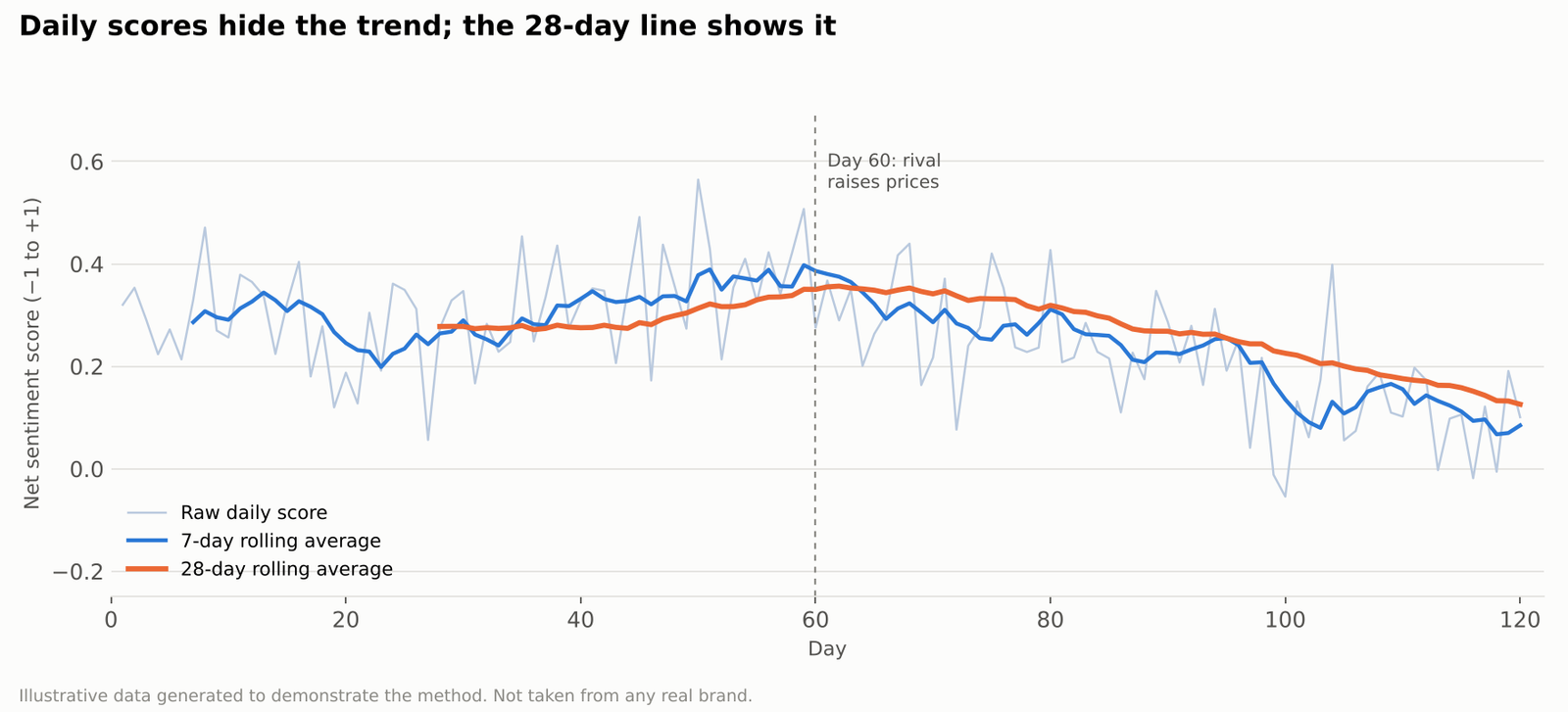
Line chart of illustrative competitor net sentiment over 120 days, comparing a noisy raw daily line with smoother 7-day and 28-day rolling averages, with a price rise marked on day 60
If you only looked at the daily line, you would see good days after the price rise and might miss the trend. The 28-day line removes that doubt. This is the core of good competitor sentiment analysis: let the long line decide, and use the short line to spot sudden shocks.
7 Advanced Tools for Competitor Sentiment Analysis
The competitor sentiment analysis tools below are grouped by the job each does best. Prices and features change often, so treat the figures here as a starting point and confirm them before you buy.
1. Brandwatch: Deep Enterprise Listening
Best for: large teams that need a long history and complex queries.
Brandwatch is one of the most established social listening tools for enterprise brands. It pulls mentions from social networks, news, blogs, forums and review sites, then applies AI sentiment scoring and real-time alerts. Its strength is flexibility. You can build detailed queries that separate a rival’s product line from its corporate news, and track each one as its own trend.
Watch for: pricing is custom and aimed at enterprise budgets. Coverage of some networks, including parts of Facebook, Instagram, LinkedIn and TikTok, can depend on account authentication.
2. Lumen by Talkwalker (Hootsuite): Trend and Spike Detection
Best for: spotting sudden shifts in rival conversation across many channels.
Hootsuite acquired Talkwalker in 2024. Its listening product is now sold as Lumen, powered by Talkwalker, and it replaced the older Hootsuite Listening. According to Hootsuite, Lumen monitors more than 150 million websites and over 30 social channels. It can also detect brand mentions inside images, video and audio, not just text. Dashboards hold two or more years of history for share of voice, sentiment and reach. A lighter entry version, Lumen Lite, is aimed at smaller marketing teams.
Watch for: the full version is priced for larger teams. Check which history length and channels come with the plan you choose.
3. Sprout Social: Listening Inside Your Daily Workflow
Best for: teams that already plan and publish content in Sprout.
Sprout’s Listening add-on brings competitor sentiment into the same place your team schedules posts and answers messages. Its Spike Alerts flag sudden changes in mention volume or sentiment, which is useful when a rival’s issue starts trending. Because it sits next to your own publishing data, it is easy to compare a rival’s reaction with your own.
Watch for: standard plans have been reported from about $199 per user each month, and Listening costs extra on top. Data depth depends on what each network’s API allows.
4. YouScan: Visual Listening
Best for: brands in food, fashion, beauty, drinks and other image-led categories.
Many people post photos of products without naming the brand. A caption might say “Friday treat” under a picture of a rival’s coffee cup. Text-only tools miss that mention. YouScan is known for image recognition that finds logos, products, and scenes in photos. That gives you a view of rival presence that text tracking cannot show. Plans are listed starting at about $499 a month.
Watch for: image recognition is strong for logos and products but weaker on mood. Pair it with text sentiment for a full picture.
5. Brand24: Budget-Friendly Mention Tracking
Best for: small businesses, startups and agencies starting out.
Brand24 tracks mentions across social media, news, blogs, podcasts and review sites, with sentiment labels and volume charts. It is simple to set up. You enter a rival’s name and key products, and trend lines appear within hours. A third-party price tracker reported that Brand24 changed its pricing in June 2026, with plans running from about $199 to $1,500 a month.
Watch for: sentiment is less detailed than in enterprise tools. Spot-check its labels on your own category before you trust small changes.
6. Rival IQ: Engagement Benchmarking
Best for: comparing rival engagement rates side by side.
Rival IQ focuses on competitive benchmarking rather than broad listening. You add rivals, and it compares their posting frequency, engagement rate, and top content across social channels. Its industry benchmarks help you judge whether a rival is doing well for its sector or just posting more. Capterra lists paid plans starting at around $199 per month, with a free trial.
Watch for: it measures engagement, not deep sentiment. Use it next to a listening tool, not instead of one.
7. Dolphin Radar: Instagram Activity in Depth
Best for: watching one Instagram rival’s public activity closely.
Dolphin Radar tracks public Instagram account activity. That includes which accounts a rival follows, posts it likes, follower spikes, and unusual follow patterns. It also offers data on more than 10,000 influencer accounts. This is useful for spotting a rival’s new influencer partnerships before they are announced. A cluster of new follows to creators in one niche often comes before a campaign.
Watch for: it covers Instagram only and does not score comment sentiment at scale. The company describes itself as privacy-focused and platform compliant. Those are its own claims, so read its terms and decide how you want to use the data.
Side-by-Side Comparison
Each tool covers a different part of competitor sentiment analysis. The table below compares them on the points that matter most when you make your choice.
| Tool | Best for | Main channels | Sentiment depth | Price level |
|---|---|---|---|---|
| Brandwatch | Enterprise history and custom queries | Social, news, forums, reviews | High | Custom, enterprise |
| Lumen by Talkwalker | Spikes and visual mentions | 30+ social channels, web | High | Mid to enterprise |
| Sprout Social | Listening inside daily workflow | Major social networks | Medium to high | Per user, plus add-on |
| YouScan | Image-led categories | Social, with image recognition | Medium | From about $499 a month |
| Brand24 | Small budgets | Social, news, blogs, podcasts | Medium | From about $199 a month |
| Rival IQ | Engagement benchmarking | Major social networks | Low (engagement focus) | From about $199 a month |
| Dolphin Radar | Instagram rival activity | Instagram only | Low (activity focus) | Check vendor |
Most teams need two tools for competitor sentiment analysis, not seven: one for broad sentiment and one for engagement benchmarking.
Lightweight Spot-Checks: Where Viewer Tools Fit
Sometimes you do not need a dashboard. You just want to see what a rival is pushing today.
Checking a Rival’s Public Stories
Instagram Stories often feature flash sales, limited-time offers, and early-launch teasers that never appear in the main feed. Tools like Iganony, an anonymous Instagram viewing tool for browsing public Stories privately, can show you what a rival is running in Stories right now.
Be clear about what that gives you. It is a look, not data:
- No sentiment. You see the Story, not how people reacted to it.
- No history. Stories expire after 24 hours, so you only see today.
- No trend line. One view cannot show direction.
Use any third-party viewer with care. Instagram restricts accounts it links to unauthorized data scraping, and its help page on scraping restrictions explains how this works. Never enter your Instagram login into an outside viewer tool. Check the site’s address and reputation before you use it.
A better habit is to log what you see. Each time you check, note the offer, the date, and the type of Story in a shared sheet. After a month, those notes become a pattern, such as “Rival runs discounts every second Thursday.” That turns a spot-check into a small piece of competitor engagement tracking.
Data Limits That Skew Competitor Sentiment Analysis
Every tool used for competitor sentiment analysis has blind spots. Knowing them keeps you from acting on a non-existent trend.
Platform Access Gaps
Meta shut down CrowdTangle, its public content tracking tool, in August 2024. Its replacement, the Meta Content Library, is aimed at approved researchers, not brand marketers. So third-party tools now depend on narrower data routes for Facebook and Instagram. Coverage of Instagram, TikTok and LinkedIn varies a lot between tools. Some only cover accounts that you connect yourself.
Before you buy, ask each vendor one plain question: “For a rival’s public Instagram account, which data can you see, and how far back?”
Sentiment Accuracy Problems
AI sentiment models still struggle with:
- Sarcasm, such as “Great, my order is late again.”
- Slang and in-group jokes
- Emojis that flip meaning by context
- Posts that mix two languages
Run a simple test each month. Pull 50 random mentions of one rival, label them yourself as positive, negative, or neutral, and compare with the tool’s labels. If more than one in five disagree, treat small changes in the sentiment trend with caution.
Bots and Brigading
A sudden wave of negative mentions can come from bots or a coordinated group rather than real customers. Before you act on a spike, check:
- Are most posts from new accounts with few followers?
- Do many posts use the same wording?
- Did engagement from established accounts change at all?
If the answers point to a campaign, note it as an event and keep watching the 28-day line.
A Weekly Competitor Monitoring Routine
Competitor sentiment analysis only helps if someone does it on a schedule. This routine takes about 30 minutes a week.
Monday: review the trend. Check each rival’s 28-day net sentiment and share of voice. Note any line that changed direction.
Wednesday: add event notes. Mark rival launches, campaigns, price changes and public issues from the past week on your timeline.
Friday: flag and share. Write two or three lines for your team: what changed, the likely cause, and one possible response.
Keep everything in one shared sheet with these columns: date, rival, 28-day sentiment, share of voice, engagement rate, event and action. After three months, you will have a history no tool can sell you, because it includes your own team’s reading of events.
Turning Rival Sentiment Into Decisions
Competitor sentiment analysis matters only when it changes what you do. Here are common patterns and smart responses.
- A rival’s sentiment falls after a price rise. Test a message about value or price stability in your ads.
- Complaints about a rival’s support climb. Show your response times and support options on landing pages.
- A rival’s sentiment rises after a feature launch. Review whether your roadmap answers the same need.
- A rival’s share of voice jumps with flat sentiment. They are spending, not winning. Watch before you react.
- A rival follows many creators in one niche. Expect an influencer push and plan your own content for that audience.
From the Analyst’s Desk: Patterns Worth Knowing
Some patterns recur in competitor sentiment analysis work.
- Volume spikes fool people more than sentiment drops. A loud week is not always a bad week.
- Small rivals show change first. Their audiences react faster and more openly than those of large brands.
- Review sites lag social media. A shift on social often reaches review scores weeks later.
- The best insight is usually the cause, not the score. Event notes are what turn charts into decisions.
Frequently Asked Questions
What is competitor sentiment analysis?
It is the practice of tracking how people feel about rival brands over time, using mentions from social media, reviews, news and forums. The goal is to spot changes in direction and link them to causes.
How accurate are AI sentiment tools?
Accuracy varies by tool, language and category. Sarcasm, slang and emojis cause the most errors. Test your tool each month by labeling a random sample of mentions yourself and comparing results.
Can you legally track a competitor’s Instagram engagement?
Tracking public posts and engagement is common practice. But Instagram’s terms restrict unauthorized automated data collection, so check how any tool gathers its data and read its terms before you rely on it.
What is the difference between share of voice and sentiment?
Share of voice measures how much of the conversation a brand owns. Sentiment measures whether that conversation is positive or negative. A rival can have a high share of voice and poor sentiment simultaneously.
How often should you check competitor sentiment?
Review trends weekly and set alerts for sudden spikes. Daily checks often lead to overreacting to noise.
Is there a free way to start competitor engagement tracking?
Yes. Use each platform’s public pages to log rival posts, engagement, and offers in a spreadsheet each week. It takes more time, but it builds a useful baseline before you pay for a tool.

Stassi Schroeder Net Worth: How She Built Her $2 Million Fortune

Harlow Andrus: The Real Story of Nancy McKeon’s Daughter

Sean Hannity Net Worth: Inside His Wealth, Career and Homes

Neil deGrasse Tyson Net Worth: How He Built His $5 Million Fortune

Competitor Sentiment Analysis: 7 Tools to Stop Guessing

Who Is Rachel Catudal? Everything About Brandon Quinn’s Wife

Tomi Lahren Net Worth: Salary Career and How She Built Her Wealth

Why Branded Notebooks Remain a Corporate Merchandise Essential

Jeremy Yaffe: The Full Story of Alan Arkin’s First Wife

John Abraham Hewson: What We Know About Bono’s Youngest Son

Charfen.co.uk: What Is It and What Does It Offer?

Diandra Luker: The Real Story of Michael Douglas’ Ex-Wife

Voozon.com: Everything You Need to Know Before Using It

Jack Scott Ramsay: What Happened to Gordon Ramsay’s Son?

Kerri Browitt Caviezel: Everything to Know About Jim Caviezel’s Wife

The Story of Jeannine Belleguic: What Public Records Really Reveal

SoSoActive: Everything You Need to Know About the Digital Platform

From Search Visibility to Enquiries: Building a Stronger SEO System in Essex

FintechZoom.com: Is It Useful for Financial Research?

Michele Morrone Net Worth: His Salary, Earnings, and Rich Life
Stassi Schroeder Net Worth: How She Built Her $2 Million Fortune
Harlow Andrus: The Real Story of Nancy McKeon’s Daughter
Sean Hannity Net Worth: Inside His Wealth, Career and Homes
Neil deGrasse Tyson Net Worth: How He Built His $5 Million Fortune
Competitor Sentiment Analysis: 7 Tools to Stop Guessing
Who Is Rachel Catudal? Everything About Brandon Quinn’s Wife
Tomi Lahren Net Worth: Salary Career and How She Built Her Wealth
Why Branded Notebooks Remain a Corporate Merchandise Essential
Jeremy Yaffe: The Full Story of Alan Arkin’s First Wife
John Abraham Hewson: What We Know About Bono’s Youngest Son
-

 News2 months ago
Who Is Gigi Yallouz? Meet Owain Yeoman’s Wife and Jewelry Designer
-

 News2 months ago
Rajesh Nihalani: What We Know About Archie Panjabi’s Husband
-

 News2 months ago
Who Is Tove Torvalds? All About Linus Torvalds’ Wife
-

 News2 months ago
Stephan Farmiga: Everything to Know About Vera Farmiga’s Brother