
Blog
Small Batch CNC Machining: Cost, DFM & Supplier Guide


Quick Answer
Evaluating suppliers for Small Batch CNC Machining (typically 10 to 100 parts) requires shifting focus from hourly machine rates to the total cost equation. Key evaluation criteria include:
- NRE Amortization: The primary cost driver at this volume is Non-Recurring Engineering (NRE)—programming and setup. Per-part cost drops by 60% to 70% when moving from 1 to 10 units, then flattens. Evaluate quotes based on how efficiently the supplier amortizes this NRE.
- DFM for Batch Size: Small batches do not justify expensive dedicated fixtures. Look for suppliers that use soft jaws or modular fixtures and can advise on standardizing hole sizes and internal radii to reduce machining time.
- Batch Consistency Data: A single good sample is not enough. Require First Article Inspection (FAI) on the first few parts and Process Capability (Cpk) data to ensure the supplier can repeat quality across the batch.
When sourcing 10 to 100 production-grade parts, the procurement risk is often hidden in the NRE. A supplier might offer a low hourly rate, but if they require six separate setups for a complex part, the total cost will be higher than a shop that quotes a slightly higher rate but completes the job in two setups. At this volume, every extra setup adds a fixed cost that cannot be amortized away.
This guide outlines a procurement framework for evaluating Small Batch CNC Machining, focusing on cost structure, design for manufacturability (DFM), and verifiable quality data.
1. What Drives the Cost of Small Batch CNC Machining?
CNC machining costs are split between fixed costs (per batch) and variable costs (per part). The fixed costs—programming, fixturing, and first-article inspection—are incurred once, regardless of whether you order 1 part or 100 parts.
| Quantity Tier | Primary Cost Driver | Typical Per-Part NRE Share | Focus for Buyer |
| 1–10 parts | Setup + programming | 60%–70% of total part cost | Minimize unique setups |
| 10–100 parts | Setup amortization + cycle time | 15%–30% of total part cost | Optimize cycle time and fixturing |
| 100–1,000 parts | Cycle time + material | < 10% of total part cost | Justify dedicated fixtures |
Summary: For small batches, the goal is not to find the lowest hourly rate, but to minimize the number of setups and the complexity of the fixturing. A single-setup process on a 5-axis machine can be more economical than three setups on a standard 3-axis machine.
Engineers at LS Manufacturing recommend: For small batch orders, request a detailed breakdown of the setup count and the process route. A supplier that explains why they chose a specific fixturing strategy is generally more reliable than one that simply provides a single lump-sum price.
2. How to Use DFM to Reduce Small Batch Costs?
Design for Manufacturability (DFM) is critical at low volumes because there is no economy of scale to absorb design inefficiencies. The goal is to reduce machine time and avoid secondary operations.
- Standardize Features: Consolidate internal corner radii to match standard tool sizes. Avoid sharp internal corners that require EDM.
- Manage Thin Walls: Walls thinner than 0.5 mm (for metals) are prone to vibration and warping. Add ribs or gussets to stiffen tall, thin features.
- Limit Setups: Design parts so that the majority of features can be machined from one or two faces. Every additional face requires a new setup and re-fixturing.
- Tolerance Budgeting: Specify tight tolerances only on functional interfaces. Over-tolerance on non-critical features increases inspection time and scrap risk without adding value.
3. How to Verify Batch Consistency from a Supplier?
At small batch volumes, the supplier’s quality system must prove repeatability. A single good sample does not guarantee that the 50th part will match.
- First Article Inspection (FAI): Require a full dimensional layout on the first 3 parts. The report should include the CMM data for all critical features.
- Process Capability (Cpk): For critical dimensions, request Cpk data from recent production runs. A Cpk of 1.33 or higher indicates the process is stable and capable of meeting tolerance.
- Inspection Sampling Plan: Ask for the sampling plan (e.g., AQL Level II). This shows the supplier has a documented procedure for in-process inspection, not just a final visual check.
4. How Do 5-Axis Capabilities Impact Small Batch Economics?
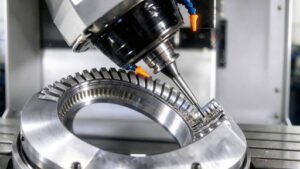
For parts with complex geometry—such as impellers, valve bodies, or multi-face brackets—the choice between 3-axis and 5-axis machining directly impacts the NRE.
| Feature | 3-Axis Machining | 5-Axis Machining |
| Setup Count | High (requires flipping for reverse features) | Low (machines 5 faces in one setup) |
| Datum Shift Risk | High (each re-fixturing introduces error) | Low (features machined from a single datum) |
| Fixturing Cost | Multiple fixtures needed | Single or minimal fixtures |
| Best For | Simple prismatic parts | Complex, multi-face, or contoured parts |
Summary: For small batches of complex parts, 5-axis machining reduces the NRE by eliminating multiple setups and the associated fixturing costs. The higher hourly rate is often offset by the reduction in total setups.
Engineers at LS Manufacturing have observed: Many procurement teams focus on the hourly rate when comparing 3-axis and 5-axis quotes. For a part with features on five faces, utilizing 5 axis cnc machining services that complete the part in one setup can be 20% to 40% cheaper overall than a 3-axis quote that requires four setups, even though the hourly rate is higher.
5. What Questions Should You Ask a Small Batch CNC Supplier?
- How many setups are included in your quote, and where is the datum picked up?
- Can you provide a FAI report on the first 3 parts and Cpk data for the critical dimensions?
- What is your process for handling out-of-tolerance parts during the batch run?
- Do you recommend any DFM changes to reduce setup or cycle time?
- For parts with features on multiple faces, do you use 3-axis or 5-axis machining, and why?
LS Manufacturing Engineer’s Avoidance Checklist
- Do not compare quotes without comparing setup counts. A low hourly rate with five setups is more expensive than a higher rate with one setup.
- Verify the NRE line items. Ask for a breakdown of programming, fixturing, and first-article inspection costs. These should be itemized, not buried in the per-part price.
- Do not skip DFM review for small batches. A one-hour design review to standardize radii and hole sizes can reduce machining time by 15% to 25%.
- Require Cpk data for critical tolerances. A single passing sample does not prove the process is stable. Cpk ≥ 1.33 is the standard benchmark.
- Confirm the inspection strategy. Specify whether inspection will be performed by CMM or hand tools, and require the data in the final report.
FAQs about Small Batch CNC Machining
Q: Why does the per-part cost drop so much between 1 and 10 units?
A: The per-part cost includes a share of the fixed NRE (programming and setup). When you order 1 unit, the full NRE is applied to that single part. At 10 units, the same NRE is spread across 10 parts, reducing the NRE share by 90%. The machining time and material cost per part remain roughly constant.
Q: Is 5-axis machining worth it for a small batch of 20 parts?
A: Yes, if the part has complex geometry. For a multi-face part, a 3-axis machine may require 4 to 6 setups. A 5-axis machine can complete the part in 1 or 2 setups. The savings from reduced fixturing and setup time often outweigh the higher hourly rate, even at 20 parts.
Conclusion
Selecting a supplier for Small Batch CNC Machining requires looking past the hourly rate and evaluating the NRE structure, the DFM discipline, and the quality evidence. By requesting a breakdown of setups, a DFM review, and Cpk data, buyers can ensure that the quoted price reflects an efficient process and that the delivered parts meet the required tolerance across the entire batch.
About the Author
Gloria is a Rapid Prototyping & Rapid Manufacturing Expert at LS Manufacturing. With 15+ years of experience, Gloria specializes in precision CNC machining, 3D printing, urethane casting, rapid tooling, injection molding, metal casting, sheet metal, and extrusion. Dedicated to helping engineering teams optimize DFM and scale seamlessly.

Using Visual Storytelling with Seedance 2.5 to Explain Environmental Changes

Renovating an Office in California? Don’t Put Client Records at Risk

How Professional Roofing Work Helps Protect and Strengthen Your Home

Helping Children Build Emotional Resilience and Develop Healthy Responses to Everyday Challenges

QVC and the Everyday Wardrobe: How to Make More Out of the Clothes You Own

What to Look for in a Trusted Real Estate Expert in Arizona

How to Keep Holiday Sales From Becoming a January Cash Crisis

5 Axis CNC Machining Services for Complex Components: A Buyer’s Guide

Small Batch CNC Machining: Cost, DFM & Supplier Guide

How Stimulant Medications Affect the Brain Long-Term

How to Make Kofta Kebabs at Home Without Overthinking It

Michele Morrone Net Worth: His Salary, Earnings, and Rich Life

Oleksandra Zelenska: Who Is Volodymyr Zelensky’s Daughter?

Ethan Klein Net Worth: YouTube H3 Podcast and His Wealth

Parke Official and Mixed Emotions: Everyday Style Meets Modern Streetwear

Patricia Azarcoya Schneider: Everything You Need to Know About Rob Schneider’s Wife

Who Is Angel Iris Murphy Brown? All About Mel B’s Child

Phil Wickham Net Worth: His YouTube Income, Tours, and Wealth

Beyond the Interior: Home Improvements That Transform Your Entire Property

Kai Dugan: Everything to Know About Jennifer Connelly’s Son
Using Visual Storytelling with Seedance 2.5 to Explain Environmental Changes
Renovating an Office in California? Don’t Put Client Records at Risk
How Professional Roofing Work Helps Protect and Strengthen Your Home
Helping Children Build Emotional Resilience and Develop Healthy Responses to Everyday Challenges
QVC and the Everyday Wardrobe: How to Make More Out of the Clothes You Own
What to Look for in a Trusted Real Estate Expert in Arizona
How to Keep Holiday Sales From Becoming a January Cash Crisis
5 Axis CNC Machining Services for Complex Components: A Buyer’s Guide
Small Batch CNC Machining: Cost, DFM & Supplier Guide






