Business
Stop Guessing and Start Tracking with These Essential Email Analytics

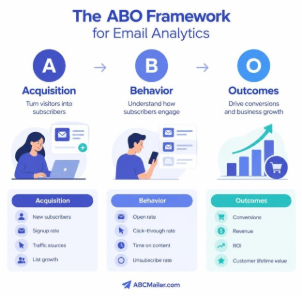
The ABO Framework: Structuring Email Marketing Measurement
To truly master email marketing analytics, we need a structured approach that goes beyond isolated metrics. This is where the Acquisition, Behavior, Outcomes (ABO) framework becomes invaluable. The ABO framework provides a comprehensive lens through which to view your email campaigns, tracking the entire customer journey from the moment someone joins your list to their ultimate interactions and conversions. It helps us understand the full measurement stages, track conversion paths, and conduct cross-channel analysis, ensuring we don’t miss crucial insights.
By segmenting our analysis into these three distinct phases—how we acquire subscribers, what they do after engaging with our emails, and the ultimate business results—we can identify strengths, pinpoint weaknesses, and optimize our strategies for maximum impact. This holistic view ensures that every email we send contributes meaningfully to our broader marketing and business objectives.
Let’s look at how metrics align with each stage of the ABO framework:
Stage Key Metrics Acquisition Delivery Rate, Click-to-Deliver Rate (CTDR), Subscriber Retention Rate, List Growth Rate, Bounce Rate (for deliverability) Behavior Click-Through Rate (CTR), Time on Site, Pages per Session, Bounce Rate (for website visits), Conversion Rate (email to site), Engagement Rate (replies, forwards) Outcomes Macro Conversion Rate (e.g., purchase, demo request), Micro Conversion Rate (e.g., download, video view), Average Revenue per Email Sent, Average Economic Value per Email Sent, Profitability Acquisition Metrics: Delivery Rate, CTDR, and Subscriber Retention
The first stage of the ABO framework focuses on how effectively we’re reaching our audience and maintaining our subscriber base. The key metrics for email acquisition include delivery rate, open rate (though with caveats we’ll discuss), click-to-deliver rate, and subscriber retention rate.
Delivery Rate is foundational, indicating the percentage of emails that successfully reach your subscribers’ inboxes. It’s calculated as: (# emails sent – # bounces) / # emails sent. Tracking delivery rate helps us identify potential issues with our email service provider (ESP), list hygiene, or even sender reputation. Effective bounce tracking is crucial here, as high bounce rates can signal problems that impact future deliverability. Segmenting delivery rates by ESP, as suggested by experts, can reveal which providers might be causing issues.
While Open Rate has historically been a primary acquisition metric, its reliability has significantly diminished by October 2026 due to privacy changes like Apple Mail Privacy Protection (MPP) and the rise of AI summarizers. We’ll delve deeper into this later, but for now, understand that it’s often only directionally accurate because many email programs block images and scripts by default.
Click-to-Deliver Rate (CTDR), however, remains a robust indicator. Calculated as: # clicks / # emails delivered, CTDR is a key measure of both the quality of your email list and the effectiveness and relevance of your message. A high CTDR suggests that your audience is engaged and your content resonates with them, prompting action. It helps us assess how well our subject lines and preheaders entice clicks from those who actually receive the email.
Finally, Subscriber Retention Rate measures the health and longevity of your email list. It’s calculated as: (# subscribers – bounces – unsubscribes) / # subscribers. This metric reflects both the technical effectiveness of your email campaigns over time and the ongoing relevance of your messages. A declining retention rate can signal content fatigue, poor segmentation, or a mismatch between subscriber expectations and actual content. Monitoring deliverability signals like spam complaints and unsubscribes is critical for maintaining a healthy list and strong sender reputation.
On-Site Behavior: Tracking Post-Click Engagement and Bounce Rate
Once a subscriber clicks a link in your email, the journey shifts to the “Behavior” stage. This phase is about understanding what happens after the click and how effectively your email drives desired actions on your website or landing pages.
Measuring website behavior after an email click is paramount. It helps us gauge the quality of the traffic we’re sending and the effectiveness of our landing pages. Key metrics here include session duration, pages per session, and visit depth. Are users spending time on your site, exploring content, or quickly leaving? This behavioral intent provides valuable feedback on whether the email’s promise aligns with the landing page experience.
A critical metric in this stage is Bounce Rate for email campaign visits. This refers to the percentage of visitors who leave your website after viewing only one page, having arrived from an email campaign. A high bounce rate for email-driven traffic can indicate several issues:
- Misleading email content:The email promised something different from what the landing page delivered.
- Poor landing page experience:The page is slow, difficult to navigate, or not mobile-friendly.
- Irrelevant offer:The call to action (CTA) on the landing page doesn’t match the user’s intent after clicking the email.
Bounce rate for email campaign visits helps you find opportunities for immediate improvement, such as optimizing specific pages and calls to action you should test. By analyzing which links lead to high bounce rates, we can refine our email content, improve landing page relevance, and ensure a seamless user experience. Conversely, low bounce rates and high engagement metrics like pages per session suggest that your email campaigns are effectively guiding users to valuable content and experiences.
Business Outcomes: Macro Conversions, Micro Conversions, and Profitability
The “Outcomes” stage is where we measure the ultimate business impact of our email marketing efforts. This goes beyond clicks and engagement to focus on tangible results that contribute to your bottom line.
We categorize outcomes into two types:
- Macro Conversions:These are the primary goals of your email campaign, directly contributing to revenue or core business objectives. Examples include product purchases, service sign-ups, demo requests, or lead form submissions.
- Micro Conversions:These are smaller, valuable actions that indicate progress towards a macro conversion or demonstrate significant engagement. Examples include downloading a whitepaper, watching a product video, adding an item to a cart, or subscribing to a blog.
Tracking both macro and micro conversions provides a holistic view of your campaign’s success. Average Economic Value per Email Sent encompasses macro plus micro conversions and is often considered the most important metric for email campaigns because it captures total business impact, assigning value to all meaningful interactions.
Beyond conversion rates, measuring profitability is crucial. It’s not enough to generate revenue; we need to ensure our campaigns are financially viable. Profitability considers not just the revenue generated but also the costs associated with the campaign. The formula is: Profitability = (revenue generated – campaign cost – cost of goods sold) / # of emails sent. This metric forces us to consider cost allocation and campaign margins. By measuring profitability, we can determine which campaigns truly deliver a positive return on investment (ROI) and optimize our spending accordingly. This ensures that our email marketing isn’t just busy work, but a genuine profit center.
Core Performance Metrics: From Deliverability to Economic Value
Moving from the structured ABO framework, let’s delve into specific core performance metrics that are vital for gauging the health and effectiveness of your email marketing in October 2026. These metrics help us with revenue attribution, understanding customer lifetime value, ROI tracking, and maintaining robust data hygiene.

Calculating Average Revenue and Economic Value per Send
When evaluating the financial success of email campaigns, two metrics stand out: Average Revenue per Email Sent and Average Economic Value per Email Sent.
Average Revenue per Email Sent focuses on the direct financial return. It’s calculated as: Total Revenue / # of emails sent. This metric stresses productivity and forces quality in your email campaigns because it mandates that the list be very clean and targeted. A higher average revenue per email indicates that your campaigns are effectively driving sales or direct revenue contributions. This metric is particularly useful for e-commerce businesses or campaigns with clear, direct purchase goals.
Average Economic Value per Email Sent, however, offers a more comprehensive view. As mentioned earlier, this metric encompasses both macro and micro conversions, assigning a monetary value to all meaningful actions a subscriber takes. For instance, if a whitepaper download is valued at $10 (based on its contribution to lead nurturing and eventual sales), and a product purchase is $100, the economic value accounts for both. This is often calculated by assigning goal values to various micro-conversion events within your analytics platform and then summing these values alongside macro conversion revenue. It is the most important metric for email campaigns because it provides a holistic valuation of your efforts, reflecting not just immediate sales but also pipeline impact, lead actions, and overall list productivity. It helps justify investments in list acquisition and content creation by demonstrating the full spectrum of value generated.
The Shift Beyond Vanity Opens to Real Engagement
In the past, open rates were often hailed as a primary indicator of email campaign success. However, by October 2026, this metric has largely become noise. The introduction of Apple Mail Privacy Protection (MPP) and the increasing sophistication of AI summarizers have fundamentally altered how opens are tracked, making them unreliable for true engagement measurement. MPP, for instance, pre-fetches and caches images, artificially inflating open counts regardless of whether a human subscriber actually viewed the email. AI summarizers can also interact with emails in ways that trigger “opens” without genuine human interaction.
This shift means we need to look beyond vanity metrics and focus on what truly matters: real, measurable engagement.
Here are the primary modern engagement indicators that provide a more accurate picture of campaign performance:
- Reply Rate:Especially critical for outbound sales or highly personalized campaigns, reply rate (often with AI-classified sentiment) indicates genuine interest and direct interaction. It’s a gold-standard outbound metric.
- Click-Through Rate (CTR) on a Clean Link:While open rates are noisy, clicks are still useful. A clean link (one that isn’t pre-fetched or manipulated by privacy tools) indicates a deliberate action by the subscriber to engage further with your content.
- Meetings Booked per Send:For B2B or service-oriented businesses, the number of meetings or appointments booked directly from an email campaign is a powerful outcome metric, signifying high intent and conversion.
- Bounce Rate and Complaint Rate:These are crucial deliverability health indicators. High bounce or complaint rates signal problems with list hygiene or content relevance, impacting your sender reputation and future deliverability.
- Unsubscribe Rate:While seemingly negative, a healthy unsubscribe rate indicates that your list is self-cleaning, removing disengaged subscribers and helping maintain a relevant audience. A sudden spike, however, warrants investigation.
Focusing on these metrics allows us to make data-driven decisions based on tangible actions rather than potentially misleading signals.
Implementing ABCMailer Real-Time Analytics for End-to-End Campaign Tracking
Effective email marketing in 2026 demands more than just basic send and open reports; it requires sophisticated, real-time data instrumentation and attribution modeling. This is precisely where a platform like ABCMailer comes into play, offering robust solutions for end-to-end campaign tracking. Leveraging ABCMailer’s robust features can transform your approach from reactive to proactive, enabling sequence iteration and optimizing performance with precision.

ABCMailer’s real-time analytics platform provides immediate insights into how your campaigns are performing, allowing you to react swiftly to trends and anomalies. This level of detail is crucial for making informed decisions on the fly, whether it’s adjusting a subject line, segmenting an audience further, or pausing an underperforming campaign.
Unlocking Full Attribution with ABCMailer Real-Time Analytics
One of the most significant challenges in digital marketing is accurate conversion attribution. In a multi-touch world, understanding which touchpoints contributed to a conversion is complex. ABCMailer real-time analytics excels in this area, offering advanced attribution modeling capabilities.
By integrating with your CRM and other marketing platforms, ABCMailer helps you track the full customer journey, from the initial email click to the final conversion and beyond. This means you can accurately attribute downstream revenue to specific email campaigns, segments, and even individual emails. The platform allows for segment roll-up, providing granular insights into how different audience segments respond and convert. This comprehensive view helps you move beyond last-click attribution, understanding the true impact of email in a multi-channel environment. With ABCMailer, you can see how email interactions influence other channels and contribute to overall business growth, making a clear case for email’s ROI.
Automated UTM Tagging and Data Pipeline Setup via ABCMailer Real-Time Analytics
Accurate tracking hinges on consistent and correct implementation of UTM parameters. Manually tagging every link in every email can be tedious and prone to error, leading to messy data and unreliable attribution. ABCMailer’s real-time analytics streamlines this process with automated UTM tagging.
The platform ensures that every link sent through your campaigns is automatically appended with the correct UTM parameters (source, medium, campaign, content, term). This not only ensures tracking hygiene but also creates a clean, consistent first-party data pipeline. Every click is logged with rich contextual information, allowing for detailed analysis in your analytics tools. This automated parameter enforcement guarantees that your data is reliable, enabling precise click logging and accurate measurement of post-click behavior. By eliminating manual errors and standardizing your tracking, ABCMailer empowers you to make data-driven decisions with confidence, knowing your attribution data is sound.
Navigating Modern Analytics Challenges and Privacy Shifts
The landscape of email analytics is constantly evolving, presenting new challenges that demand adaptive strategies. In October 2026, privacy changes, email security concerns, the rise of sentiment analysis, and sophisticated inbox algorithms all impact how we measure and interpret campaign performance.

Managing Apple MPP and AI Content Summarizers
Perhaps the most significant challenge to traditional email analytics stems from privacy enhancements, notably Apple Mail Privacy Protection (MPP), introduced in late 2021. MPP, along with similar privacy features and the growing use of AI summarizers, has fundamentally altered the reliability of the open rate metric.
Here’s how they impact our data:
- Apple MPP (and similar privacy features):These systems pre-fetch and cache email content, including tracking pixels, when an email arrives in a user’s inbox, regardless of whether the user actually opens or views the email. This results in artificially inflated “machine opens” or “bot clicks,” making the reported open rate largely directional at best, and often just noise. It becomes nearly impossible to distinguish a true human open from an automated system’s pre-fetch.
- AI Summarizers:As AI tools become more prevalent, they can interact with emails to generate summaries for users, potentially triggering tracking pixels without the user ever seeing the full email. This further contributes to the unreliability of open metrics.
The implication is clear: relying solely on open rates for campaign optimization or performance evaluation is a flawed strategy. While open rates might still offer a very broad directional signal of subject line effectiveness, they should not be used for precise measurement of engagement or reach. Marketers must shift their focus to more actionable metrics like clicks, conversions, and replies to truly understand campaign effectiveness.
Protecting List Health Through Clean Permission and Low Complaints
In an era of heightened privacy awareness and sophisticated inbox filtering, maintaining a healthy email list and a strong sender reputation is paramount. This starts with permission marketing, which should be the foundation for all your email campaigns. Only send emails to individuals who have explicitly opted in and consented to receive communications from you.
Beyond initial consent, continuously monitoring and managing list health is critical:
- Spam Complaints:A high complaint rate is a major red flag for Internet Service Providers (ISPs) and can severely damage your sender reputation, leading to lower deliverability. Promptly remove subscribers who mark your emails as spam.
- One-Click Unsubscribe:Make it easy for subscribers to opt-out by including a clear, one-click unsubscribe link in every email. While it might seem counterintuitive to lose subscribers, a healthy unsubscribe process ensures that your remaining list is engaged and genuinely interested in your content. It also prevents frustrated subscribers from marking your emails as spam.
- List Scrubbing:Regularly clean your email list by removing inactive subscribers, hard bounces, and those who haven’t engaged in a long time. This process, known as list scrubbing, improves your overall deliverability and ensures you’re only sending to an engaged audience, which positively impacts your CTDR and other engagement metrics.
- Sender Reputation:Your sender reputation is a score assigned by ISPs that determines whether your emails land in the inbox or the spam folder. It’s influenced by factors like bounce rates, complaint rates, unsubscribe rates, and engagement. By adhering to permission marketing best practices and actively managing list health, you protect and enhance your sender reputation, ensuring your valuable emails reach their intended recipients.
Frequently Asked Questions about Email Marketing Analytics
What is the ABO framework in email campaign analysis?
The ABO framework stands for Acquisition, Behavior, and Outcomes. It’s a structured approach to measuring email marketing performance by breaking down the customer journey into three distinct stages. The Acquisition stage focuses on how you gain subscribers and ensure your emails are delivered (e.g., delivery rate, subscriber retention). The Behavior stage tracks what subscribers do immediately after interacting with your email, typically on your website (e.g., click-through rate, time on site, bounce rate on landing pages). The Outcome stage measures the ultimate business results and conversions driven by your emails, both macro and micro (e.g., purchases, leads, average economic value per email). This framework provides a full-funnel measurement, ensuring comprehensive analysis beyond isolated metrics.
Why are open rates less reliable in 2026?
By October 2026, email open rates have become significantly less reliable due to several technological and privacy advancements. The primary culprit is Apple Mail Privacy Protection (MPP), which pre-fetches and caches email content, including tracking pixels, when an email arrives in an inbox, regardless of whether the user actually views it. This creates “machine opens” or “privacy caching,” artificially inflating open counts. Additionally, the rise of AI summarizers can interact with emails in ways that trigger open pixels without human interaction. These factors mean that open rates are now largely noise, providing only a directional signal at best, rather than an accurate measure of human engagement. Marketers should prioritize clicks, replies, and conversions as more trustworthy indicators.
How does economic value per email differ from revenue per email?
Average Revenue per Email Sent typically focuses on direct, tangible revenue generated from an email campaign, such as sales or subscriptions, divided by the number of emails sent. It’s a straightforward measure of direct financial return.
Average Economic Value per Email Sent, however, offers a more holistic valuation. It encompasses both direct revenue (macro conversions) and the assigned monetary value of indirect, smaller, but still valuable actions (micro conversions), such as whitepaper downloads, video views, or adding items to a cart. These micro conversions contribute to the sales funnel and ultimately to revenue, even if not directly generating a sale themselves. By assigning a value to these actions, the economic value metric provides a more comprehensive picture of a campaign’s total business impact and its contribution to the overall pipeline, making it a more robust measure of list productivity and overall campaign success.
Conclusion
In the dynamic digital landscape of October 2026, email marketing remains a cornerstone of effective communication and revenue generation. However, its continued success hinges on a sophisticated, data-driven approach to analytics. Moving beyond vanity metrics and embracing frameworks like ABO empowers us to achieve true performance optimization.
By meticulously tracking acquisition, understanding post-click behavior, and accurately measuring business outcomes—both macro and micro—we can unlock profound insights into our campaigns. The shift away from unreliable open rates towards tangible engagement signals like clicks, replies, and conversions is not just a trend, but a necessity. Furthermore, leveraging advanced platforms that offer real-time analytics, automated UTM tagging, and robust attribution modeling, such as ABCMailer’s real-time analytics platform, is crucial for navigating the complexities of modern email tracking and ensuring every email contributes meaningfully to our goals.
A commitment to data-driven strategy, sustainable deliverability through permission marketing, and continuous iteration based on comprehensive analytics will define the most successful email marketers. Stop guessing, start tracking, and transform your email marketing into a powerful, measurable engine for growth.

The Business Fundamentals That Matter Most: Quiet Skills That Stand the Test of Time

Beyond First Impressions: Building Trust and Growth in Financial Advisory

How to Manage Exam Anxiety During the Leaving Cert

How To Build A Cash Reserve That Keeps Pace With Living Costs

Stop Guessing and Start Tracking with These Essential Email Analytics

IT Support for Small Business: What You Need to Know

PPC Advertising: What Every Small Business Should Know

Teeth Whitening: What Actually Works and Why

Understanding Depression: Types, Signs, and Treatment

How Animals Support Mental Health Recovery

How to Make Kofta Kebabs at Home Without Overthinking It

Ethan Klein Net Worth: YouTube H3 Podcast and His Wealth

Oleksandra Zelenska: Who Is Volodymyr Zelensky’s Daughter?

Patricia Azarcoya Schneider: Everything You Need to Know About Rob Schneider’s Wife

Who Is Angel Iris Murphy Brown? All About Mel B’s Child

Phil Wickham Net Worth: His YouTube Income, Tours, and Wealth

Beyond the Interior: Home Improvements That Transform Your Entire Property

Kai Dugan: Everything to Know About Jennifer Connelly’s Son

Nicole Aniston Net Worth: Career, Income, and Wealth Explained

Reza Pahlavi Net Worth: How Rich Is Iran’s Former Crown Prince?
The Business Fundamentals That Matter Most: Quiet Skills That Stand the Test of Time
Beyond First Impressions: Building Trust and Growth in Financial Advisory
How to Manage Exam Anxiety During the Leaving Cert
How To Build A Cash Reserve That Keeps Pace With Living Costs
Stop Guessing and Start Tracking with These Essential Email Analytics
IT Support for Small Business: What You Need to Know
PPC Advertising: What Every Small Business Should Know
Teeth Whitening: What Actually Works and Why
Understanding Depression: Types, Signs, and Treatment