
Health
10 Leading Healthcare Software Development Companies for Improving Medication Adherence Without Adding Clinician Workload in 2027

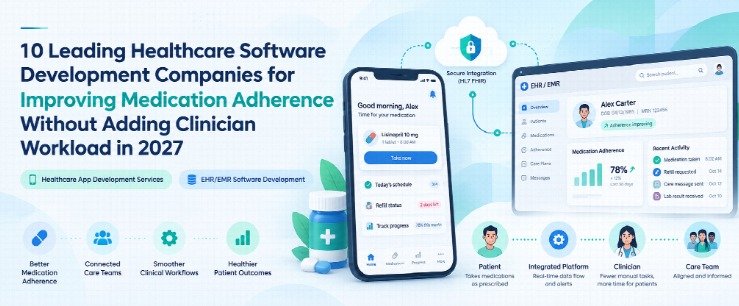
Medication adherence remains a challenge for healthcare organizations, particularly when patients manage chronic conditions or follow complex medication schedules. Missing doses, delaying refills, or struggling to follow treatment plans can affect continuity of care and make it harder for clinicians to understand what happens between appointments.
Healthcare software development companies offering healthcare app development services can help address these gaps through medication reminders, refill tracking, and patient monitoring tools. However, poorly integrated systems can add alerts, documentation, and follow-up tasks to already busy clinical teams. In 2027, healthcare organizations evaluating development partners must look beyond features to assess patient engagement, clinical workflow integration, and actionable adherence insights that support care without adding unnecessary work.
What Should Healthcare Organizations Look for in Medication Adherence Software?
Medication adherence software should help patients follow treatment plans without giving clinicians another system to manage. Reminders and refill prompts can help, but patients may also need a way to report side effects, explain missed doses, or ask questions about their medication schedules.
Integration matters just as much. When medication records exist across separate pharmacy systems, EHRs, and patient apps, staff may have to enter the same information twice or switch between screens to piece together a patient’s history. EHR/EMR software development expertise can help organizations address these integration challenges and make medication information accessible within existing clinical workflows.
Automation should distinguish between routine activity and issues that need attention while also taking security into consideration. Access controls, audit logs, and safeguards for patient data should reflect applicable privacy requirements. Teams should also measure whether patients engage with the software and whether adherence improves, rather than treating app activity as proof that someone took their medication.
The right development partner should understand these clinical and technical demands and show how its solutions fit existing workflows.
10 Healthcare Software Development Companies to Consider for Medication Adherence in 2027
This list considers Clutch ratings and review counts alongside healthcare experience, mobile and custom software development, and capabilities relevant to patient engagement and clinical system integration. These capabilities do not, on their own, establish that a company has delivered measurable improvements in medication adherence.
1. GeekyAnts
GeekyAnts is an AI-Powered Digital Product Engineering & Consulting Company providing product engineering capabilities spanning mobile and web applications, AI, and backend systems. Their healthcare app development services support organizations building patient-facing applications that need to connect with existing healthcare infrastructure. For medication adherence projects, healthcare organizations should assess how their team would connect patient-facing tools with existing clinical systems, handle patient data, and design alerts that help care teams identify when follow-up may be needed.
Clutch Rating: 4.8/5 (120 reviews)
Address: GeekyAnts Inc, 315 Montgomery Street, 9th and 10th floors, San Francisco, CA, 94104, USA,
Phone: +1 845 534 6825, Email: info@geekyants.com, Website: www.geekyants.com/en-us
2. AppVerticals
AppVerticals develops mobile applications and custom software, with services covering iOS, Android, cross-platform development, product design, backend engineering, and AI. This combination may suit a patient adherence platform that needs medication reminders, refill tracking, and a mobile interface connected to supporting services. Healthcare buyers should confirm the team’s experience with clinical integrations, patient privacy, and healthcare-specific requirements.
Clutch Rating: 4.8/5 (29 reviews)
Address: 1341 W Mockingbird Ln, Suite 600W, Dallas, TX 75247, USA.
Phone: +1 833 888 2433
3. Quartus Technology, Inc.
Quartus Technology develops mobile applications and offers AI development, with health and wellness represented in its mobile work. Its experience across consumer and enterprise applications may be relevant to patient tools that combine medication schedules, reminders, and backend services. Organizations should ask how the company would handle data exchange with EHRs or pharmacy systems and test whether its proposed workflow fits clinical operations.
Clutch Rating: 4.8/5 (11 reviews)
Address: 1221 Post Road East, Suite 203, Westport, CT 06880, USA.
Phone: +1 866 444 5596.
4. Inicrea Technologies LLC
Inicrea Technologies develops mobile and web applications, including products in the health and wellness category. Its iOS, Android, and web capabilities may fit projects that need a patient-facing application alongside a web-based management interface. For medication adherence, buyers should assess how the team would support accessibility, medication schedule changes, and secure data exchange between the application and other healthcare systems.
Clutch Rating: 4.7/9 (3 reviews)
Address: 30 N Gould St, Suite R, Sheridan, WY 82801, USA.
Phone: +977 9801023843
5. KRUTSCH
KRUTSCH combines mobile development, AI, and UX/UI design, with healthcare work that includes projects connected to clinical research and cardiovascular care. That experience may be relevant when a medication adherence tool needs to present clinical information in a way patients or care teams can understand and use. Buyers should examine relevant project examples and establish how the proposed design will support patient needs without adding steps to clinicians’ workflows.
Clutch Rating: 4.7/5 (20 reviews)
Address: 107 N Washington Ave, Suite 200, Minneapolis, MN 55401, USA.
Phone: +1 612 605 7549
6. Red Hawk Technologies
Red Hawk Technologies works across custom software, mobile applications, AI development, systems integration, and application support. Its integration and maintenance services may suit healthcare organizations that need a patient application to exchange information with existing systems and continue evolving after launch. Before engaging the company, buyers should clarify which integrations it can deliver, how data access will be controlled, and who will maintain the software once it enters production.
Clutch Rating: 4.8/5 (15 reviews)
Address: 1 Moock Road, Building A, Suite 202, Wilder, KY 41071, USA.
Phone: +1 859 360 5583.
7. Sonatafy Technology
Sonatafy Technology provides custom software development, mobile application engineering, and enterprise application modernization. Their delivery model may fit healthcare organizations that already have patient or care management software and need engineering support to extend it. For medication adherence projects, the key questions are how new features will work with existing systems, how the team will protect established workflows, and who will own testing and ongoing maintenance.
Clutch Rating: 4.8/5 (25 reviews)
Address: 14362 N Frank Lloyd Wright Blvd, Suite 1000, Scottsdale, AZ 85260, USA.
Phone: +1 602 740 9866.
8. Euvic
Euvic offers custom software development, mobile engineering, managed IT services, modernization, and AI solutions. Their range of services may be useful to healthcare organizations working across several connected applications rather than building a standalone patient tool. Buyers considering Euvic should ask how the team would handle integration dependencies, monitor data flows, and move a medication adherence feature from an initial build into a supported production environment.
Clutch Rating: 4.8/9 (22 reviews)
Address: 101 Hudson Street, 21st Floor, Jersey City, NJ 07302, USA.
Phone: +1 201 409 2342.
9. Iron Forge Development
Iron Forge Development builds web, mobile, and custom software products, with med-tech among the sectors represented in its work. Its services cover product planning, frontend and backend development, maintenance, and scaling. Their range of services may suit a healthcare organization that needs support across several stages of a patient application. Buyers should request examples of relevant healthcare work and confirm how the team approaches security, testing, and post-launch support.
Clutch Rating: 4.8/5 (23 reviews)
Address: Palm Beach Gardens, FL, USA.
Phone: +1 760 504 7701.
10. Activeone
Activeone provides mobile development, custom software engineering, API integration, and AI development, including generative and agentic AI solutions. Their services may fit a medication adherence platform that combines patient reminders with connected data and automated support. However, automation needs clear boundaries in healthcare. Buyers should establish which events can trigger routine patient messages, which require clinical review, and how the system will record actions for later review.
Clutch Rating: 4.8/5 (13 reviews)
Address: Orlando, FL, USA.
Phone: +1 (321) 236-0010.
How to Evaluate Fit Beyond the Feature List
Before choosing a development partner, ask how their solution will connect with existing EHRs, pharmacy systems, and care management tools. A partner with EHR/EMR software development experience should be able to explain how medication data will move between systems without creating additional documentation work. Find out which adherence signals should reach a clinician and which can trigger automated patient support. The software should also account for differences in patients’ routines, needs, and ability to use digital tools.
Ask for examples of healthcare projects, security practices, and measurable results from previous implementations. Then agree on how success will be measured, including patient engagement, adherence indicators, alert relevance, and the time clinicians spend on follow-ups. The right partner should fit the organization’s clinical workflows, technical environment, and staffing capacity.
Conclusion
Medication adherence tools should help patients manage their treatment while keeping clinical workflows manageable. Reminders and refill tracking can support daily routines, but their value depends on how well they connect with existing systems and whether they give care teams information they can act on.
Integration, usability, data privacy, and relevant alerts deserve as much attention as the feature list. Automation can flag patterns that may need attention, but clinicians must retain control over care decisions. It should also reduce avoidable follow-ups, not create more work for staff.
Before selecting a development partner, healthcare organizations should assess how the proposed solution fits their patient population, clinical workflows, and operational goals. This approach helps teams make informed choices and build adherence support they can sustain over time.

Can Machines Spot Machine Writing? A Closer Look at AI Essay Checkers

How Niche eCommerce Founders Can Validate Product Demand Before Investing in Inventory

Building a Competitive Online Presence with Link Building Services and SEO Packages

Luxury Rigid Boxes: Planning Premium Packaging Around Product Fit and Presentation

Tommy Bynes: Everything About Amanda Bynes’ Brother

How to Cook Healthy Family Meals Safely: A Parent’s Guide

How Personalized Addiction Treatment Plans Can Improve Patient Engagement and Recovery Outcomes

Need LLC Help? Here’s How to Get an LLC Online

Helen Beth Duntz: The Real Story of James MacArthur’s Wife

Cassandra Marino: The Full Story of Caitlyn Jenner’s Eldest Daughter

Charfen.co.uk: What Is It and What Does It Offer?

SoSoActive: Everything You Need to Know About the Digital Platform

Buying Property Through Your Super? Run an SMSF Loan Calculator Before You Call a Broker

Kerri Browitt Caviezel: Everything to Know About Jim Caviezel’s Wife

Voozon.com: Everything You Need to Know Before Using It

From Search Visibility to Enquiries: Building a Stronger SEO System in Essex

Eractoll: What Is It and Why Did Enterprise Charge You?

How to Make Kofta Kebabs at Home Without Overthinking It

Michele Morrone Net Worth: His Salary, Earnings, and Rich Life

NF Net Worth: How the Rapper Turned Pain Into Millions
Can Machines Spot Machine Writing? A Closer Look at AI Essay Checkers
How Niche eCommerce Founders Can Validate Product Demand Before Investing in Inventory
Building a Competitive Online Presence with Link Building Services and SEO Packages
Luxury Rigid Boxes: Planning Premium Packaging Around Product Fit and Presentation
Tommy Bynes: Everything About Amanda Bynes’ Brother
How to Cook Healthy Family Meals Safely: A Parent’s Guide
How Personalized Addiction Treatment Plans Can Improve Patient Engagement and Recovery Outcomes
Need LLC Help? Here’s How to Get an LLC Online
Helen Beth Duntz: The Real Story of James MacArthur’s Wife
Cassandra Marino: The Full Story of Caitlyn Jenner’s Eldest Daughter
-

 News2 months ago
Who Is Gigi Yallouz? Meet Owain Yeoman’s Wife and Jewelry Designer
-

 News2 months ago
Who Is Tove Torvalds? All About Linus Torvalds’ Wife
-

 News2 months ago
Rajesh Nihalani: What We Know About Archie Panjabi’s Husband
-

 News2 months ago
Stephan Farmiga: Everything to Know About Vera Farmiga’s Brother